martes, 12 de julio de 2011

CERRO MURIANO : A NEW PHOTOGRAPH MADE BY ROBERT CAPA ON SEPTEMBER 5, 1936 FOUND AND LOCATED

Text: José Manuel Serrano Esparza. LHSAEnlaceSPANISH VERSION

                                                                                                                     Foto : Robert Capa / © ICP New York

elrectanguloenlamano.blogspot.com has been able to discover a new photograph, made by Capa or Gerda Taro on September 5, 1936, which has remained practically unknown for 75 years.

It is a picture taken in the Finca of Villa Alicia


approximately 1 km in the southwest of the village of Cerro Muriano, on September 5, 1936, around 12:30 midday and in which we can see two militiamen, one of them in his forties, wearing a beret, white shirt, black trousers, dark cardigan buttoned up only in the area near his neck, and another one much younger, closer to the camera, filling the left half of the image and wearing a large blanket with some white stripes, a white shirt (whose right sleeve we can see under the blanket, occupying the lower left border of the picture) and whose chin, lips, nose and right cheekbone appear lit by the sun, in the same way as the forward and upper area of his anarchist militiaman cap - crowned by its tassle - , which bears the sickle and hammer embroidered on its upper right zone, though it doesn´t indicate his belonging to communist party, but a symbol which was also often used in the anarchist caps of C.N.T and F.A.I together with the letters U.H.P (Union of Proletarian Brothers).

This picture appears in the book ROBERT CAPA Cuadernos de Guerra en España (1936-1939) of the Image Collectio, Sala Parpalló Diputación Provincial de Valencia Edicions Alfons El Magnànim Institució Valenciana D´Estudis I Investigació of 1987, and though inside the book the caption under the picture states that the image was made in Madrid in 1936 (an understandable error, not only because of the very difficult identification and location, but also because the framing is very tight and the look upwards of both militiamen makes anybody think that it is a political rally in a big city), it actually corresponds to the series made by Capa and Taro in the Finca of Villa Alicia, on which we reported about in:

http://elrectanguloenlamano.blogspot.com/2011/04/cerro-muriano-identification-and.html

The most significant element for the identification has been the militiaman in his forties clad with a clear colour beret, who is the same person that can be seen in the first picture (upper left half) of the British newspaper The Illustrated London News from October 24, 1936, in which there are some
Enlacephotographs made by Gerda Taro and Robert Capa, a discovery made by elrectanguloenlamano.blogspot.com.

In such a photograph, this militiaman with a clear colour beret is just under another anarchist civil combatant wearing a dark cap of C.N.T or F.A.I (we can only see roughly a fourth part of it) who mainly distinguishes from the rest of militiamen because he is wearing a huge white handkerchief on his neck (on his right there is an anarchist militiaman with a short sleeved white shirt and a military cap, who is looking at Gerda Taro; and just behind the cap, there is an Andalusian militiaman with the typical clear hat of this region of Spain).

They all are attentively listening to the words addressed to them by a militiaman chief, who strives after encouraging them before the battle that will begin very soon and in which they´ll have to fight against General Varela´s troops, specially the legionnaires and the feared colonel Sáenz of Buruaga´s Moroccan Tabors of Regulares, who will try to perform the encircling manoeuver through north area of Las Malagueñas hill and a further penetration through the Finca of Villa Alicia, also attempting to encircle Torreárboles hill on its north side, linking with the legionnaires of the third Francoist column.

It all is well known in advance by the Republican high officers present in the area, mainly the majors Juan Bernal, Balibrea, Aviraneta and Captain Castañeda, who have been preparing Cerro Muriano village defense for some days, being aware about the impending attack that Francoist troops would launch on them to free Córdoba city from pressure, so they have placed abundant contingents of anarchist militiamen and regular Republican soldiers not only defending the summits of Las Malagueñas (where the Republican advanced command post in the area with Juan Bernal, Balibrea and Aviraneta is located) and Torreárboles, but also on Finca of Villa Alicia (where is Captain Castañeda, advising the anarchist militiamen), a zone of maximum risk of encircling manoeuvering, which must be defended at all cost to prevent the Francoist troops falling on the back of the defenders of the peaks of Torreárboles, who have been withstanding the attack of one of the three Francoist columns on the south side of this hill for some hours.

Once more, it can be observed the stress and anxiety on the faces of armed civilian men, lacking any military drill or prowess in the handling of guns, but being ready to face the professional troops of the Army of Africa, featuring a lot of years of experience in ruthless colonnial war in Morocco against the very tough men of the Rif.

In the image, we can also glimpse part of other three militiamen appearing in the aforementioned picture of The Illustrated London News of October 24, 1936:

a) Just over the beret, the militiaman wearing a huge white handkerchief around his neck, and whose face exceeds the boundaries of the photograph.

b) Just over the upper central area of the blanket resting on the militiaman left shoulder with clear colour beret, we can see the beginning of the short sleeve of the man clad in a white shirt and military cap (out of image, in the same way as the superior area of the face from the nose upwards).

c) Just on the far right area of the militiaman left shoulder, we can observe the right half of the body of another militiaman wearing a black beret and which in the picture of The Illustrated London News appears with the back of his dark beret - lit by the sun- nearly touching the military cap worn by the militiaman with a white shirt and a military cap probably captured during the assault of a military barracks in the preceding weeks.

We must also highlight that in this image in which appears the militiaman wearing a clear color beret - along with another younger militiaman with the sickle and the hammer on his anarchist cap-,
both the leather gun sling hanging on the area of his left shoulder nearest to his neck and what seems to be a calibre 12 shotgun, part of which protrudes over the clear colour beret of the militiaman, appear with higher level of detail than in the number of The Illustrated London News of October 24, 1936.


Copyright Text: José Manuel Serrano Esparza. LHSA. 

viernes, 8 de julio de 2011

JOSÉ HORNA SELECCIONADO POR LEICA FOTOGRAFIE INTERNATIONAL EN SU CATEGORÍA MASTER SHOTS

ENGLISH VERSION


La fotografía Impasse Lebouis (Fondation Henri Cartier-Bresson). Paris XIV realizada por el fotógrafo español José Horna ha sido seleccionada por la revista Leica Fotografie International en su categoría Master Shots, una de las más prestigiosas en el ámbito de la creación de imágenes.

http://gallery.lfi-online.de/gallery/thumbnails.php?album=lastup&cat=-3589&page=1

José Horna es un reconocido fotógrafo social, de viajes y streeter residente en Bilbao (País Vasco) que se ha especializado en la fotografía de blanco y negro, siendo además un consumado experto en la cobertura de conciertos de Jazz (campo en el que ha llevado a cabo numerosas exhibiciones fotográficas a lo largo de su carrera) con 20 años de experiencia, habiendo acreditado su talento como usuario de cámaras y objetivos Leica M y Nikon, con una trayectoria muy coherente y una notable cantidad de ensayos fotográficos y exhibiciones entre las que cabe destacar: Continuidad de París, Jazz/Photography/Liberty, Jazz Quintet (Exhibición Fotográfica), Round Jazz (Exhibición Fotográfica), Bits of Jazz (Exhibición Fotográfica), Jazzographies in All about Jazz (más de 1200 fotografías), Take the Basque Train (Jazz 2001), Sometimes in Blue (Jazz 2002), Jazz in the Mirror (Jazz 2003), Big Jazz ... Small Jazz (Jazz 2004), Where is the Jazz (Jazz 2005), Rhythm Changes - with tears - (Jazz 2006), ´No Photo!!! blues (Jazz 2007), Free Photo & Improvised Jazz (Jazz 2008), Jazz in the Bag (Jazz 2009).

LFI está considerada hoy por hoy la mejor revista de fotografía del mundo, junto con Amateur Photographer, Photo Techniques, Viewfinder, The British Journal of Photography, Digitális Fotó Magazin, Rangefinder y Leica Magazin (Italia).

Hace dos años, el 1 de Marzo de 2009, elrectanguloenlamano.blogspot.com publicó un artículo sobre el proyecto fotográfico "Continuidad de París" de José Horna:

http://elrectanguloenlamano.blogspot.com/2009/03/continuity-of-paris-photographic.html

Asimismo, el 23 de Abril de 2010, publicamos otro artículo sobre el excelente porfolio de José Horna Bits of Jazz (Getxo Jazz 2006-2008):

http://elrectanguloenlamano.blogspot.com/2010/04/bits-of-jazz-getxo-jazz-2006-2008.html


Copyright Texto: José Manuel Serrano Esparza. LHSA

JOSÉ HORNA SELECTED FOR THE LEICA FOTOGRAFIE INTERNATIONAL MASTER SHOTS CATEGORY

SPANISH VERSION

© José Horna


The picture Impasse Lebouis (Fondation Henri Cartier-Bresson). Paris XIV made by the Spanish photographer José Manuel Horna has been selected for the Leica Fotografie International Master Shots Category, one of the most prestigious ones within the picture taking scope.Enlacehttp://gallery.lfi-online.de/gallery/thumbnails.php?album=lastup&cat=-3589&page=1

José Horna is a remarkable photographer living in Bilbao (Basque Country) who has specialized on black & white photography in the genres of social, travel, and street photography, also being an accomplished expert in the Jazz concerts coverage sphere ( a domain on which he has made a number of photographic exhibitions throughout his career), featuring a twenty years old experience, having proved his prowess as a user of Leica M and Nikon cameras, with a rather coherent trajectory and a number of top-notch photographic essays and exhibitions among which we must highlight:
Continuity of Paris, Jazz/Photography/Liberty, Jazz Quintet (Photographic Exhibition), Round Jazz (Photographic Exhibition), Bits of Jazz (Photographic Exhibition), Jazzographies in All about Jazz (more than 1,200 photographs), Take the Basque Train (Jazz 2001), Sometimes in Blue (Jazz 2002), Jazz in the Mirror (Jazz 2003), Big Jazz ... Small Jazz (Jazz 2004), Wehre is the Jazz (Jazz 2005), Rhythm Changes -with tears- (Jazz 2006), ´No Photo!!! blues (Jazz 2007), Free Photo & Improvised Jazz (Jazz 2008), Jazz in the Bag (Jazz 2009).

LFI is currently deemed the best photographic magazine in the world, along with Amateur Photographer, Photo Techniques, Viewfinder, The British Journal of Photography, Digitális Fotó Magazín, Rangefinder and Leica Magazine (Italy).

Two years ago, on March 1, 2009, elrectanguloenlamano.blogspot.com published an article on EnlaceJosé Manuel Horna photographic project ´Continuity of Paris ´:

http://elrectanguloenlamano.blogspot.com/2009/03/continuity-of-paris-photographic.html

Likewise, on April 23, 2010, we publish a further article on the excellent portfolio Bits of Jazz (Getxo Jazz 2006-2008) by José Horna:

http://elrectanguloenlamano.blogspot.com/2010/04/bits-of-jazz-getxo-jazz-2006-2008.html


Copyright Text: José Manuel Serrano Esparza. LHSA

miércoles, 6 de julio de 2011

THE GANNETT FOUNDATION PHOTOGRAPHIC STUDY CENTER : REMEMBRANCES OF A DAY WITH EUGENE SMITH, LEWIS HINE, A. STIEGLITZ AND JULIA MARGARET CAMERON

Text and Photos: José Manuel Serrano Esparza. LHSA
SPANISH VERSION


Kindly attended by Joe Struble, Assistant Archivist of the George Eastman Museum of Photography and Film in Rochester (New York), elrectanguloenlamano.blogspot.com had the chance to see and touch on the spot a wide range of top-notch quality original vintage copies created by four great ones in the History of Photography: Eugene Smith, Lewis Hine, Alfred Stieglitz and Julia Margaret Cameron.


The meeting took place inside the Gannett Foundation Photographic Study Center (one of the jewels of the crown of the George Eastman House Museum, the most important shrine regarding History of Photography existing on earth along with the ICP of New York), which holds an excellent assortment of works made by many famous photographers of all times, kept and preserved with exceedingly painstaking care within large special rectangular cases designed for that purpose, each one including handcraftedly manufactured copies on baryta photographic paper, made in darkroom with huge levels of thoroughness and many hours of hard work, complemented by experience to spare, good taste and love for well made things.


Joe Struble allocating with great care some copies made by Eugene Smith himself and corresponding to his very famous series called A Spanish Village, that he made in Deleitosa (Cáceres) in 1951.


The appearance of every matte black color nice rectangular case containing real masterpieces is simply superb: they´re in a perfect condition, almost brand-new, and the hinges enabling their opening and closing don´t show even the slightest scratch.

Needless to say that each case bears on the central area of its back the name of the photographer author of the pictures inside, as happened with this one titled W.Eugene Smith: A Spanish Village, which was the first shown to us by Joe Struble, and within which there were six photographs belonging to his reportage " A Spanish Village" that he fulfilled in the village of Deleitosa (Cáceres) in 1951, and where he went far beyond making a comprehensive photographic essay with 1,575 pictures, also drawing up a 24 page rundown gleaning information on that time Spain and developing a remarkable social investigation work, writing down the names and ages of all the interviewed people and managing to get a certain empathy with the photographed persons, as well as carrying out a deep socioeconomic analysis on the hard working conditions of the post civil war Spain, the high levels of illiteracy, the frequent lack of suitable hygienic conditions, etc.


The photographic essay "A Spanish Village", published by Life magazine in a special number in which seventeen pictures made by Eugene Smith were included, was an unprecedented success in the history of that publication, with a figure of more than 22,000.000 millions of copies sold, including the original issue and the subsequent reprints.


Vintage copy made by Eugene Smith from the original negative of one of his most famous images: Death in A Spanish Village, depicting the wake of Juan Larra, a just dead old man from Deleitosa (Cáceres).

The mediocre photograph made by the author of this article doesn´t make justice to the impressive quality of this truly awesome copy on baryta paper, in which you can clearly perceive that the Genius of Wichita spent a lot of hours inside his darkroom striving after giving birth to a visual score evoking as faithfully as possible the instant of image creation.

As well as being a world class photographer, Eugene Smith was an extraordinary darkroom expert who often went into seclusion for days, working up to the end of his tether, until attaining the copy he wanted, and the standard of quality he always yearned after was so high that it put the best illustrated publications during forties, fifties, sixties and seventies in a tight fix, including Life.


Another image of the table on which we can see the rectangular protective black case and by it, five of the six vintage copies it includes, made by the very Eugene Smith and belonging to his mythical photographic essay in Deleitosa (1951):" Deleitosa (Spain)" , "After a Working´s Day", "A Young Woman´s Work", "The Threader", "Death in a Spanish Village" and "Spanish Woman".

We were really amazed at the outstanding copy of "Spanish Woman", in which we can see a Deleitosa old woman wrapped into a black attire covering her whole body, with the exception of nose, cheeks, eyebrows and forehead, while two thirds of a man´s face along with his chest upper area can be seen sideways on the upper right border of the frame.

It´s a highly powerful image, with very harsh contrasts ruled by the wide and strong solar beam illuminating part of the wall behind the old woman - together with her utter face and garment- , the black colour and plates of her attire and the large vertical stripe of the image left third. Eugene Smith´s darkroom work proves to be exquisite, achieving to keep detail both on the high key areas featuring huge power and on the strong shadows, something deserving accolades, since the high keys and deep blacks existing in the moment in which Eugene Smith made this picture in Deleitosa, exceed in intensity the extraordinary photographs Portrait of the Eternal (1935), The Crouched (1934) and even Recent Tomb (1933) Manuel Alvarez Bravo´s images.


Rectangular case with a wide assortment of pictures made by Lewis Hine between 1930 and 1931 and pertaining to his famous reportage on the building of Empire State Building of New York.

This time, they were the contacts as such, created from the original negatives (13 x 18 cm) exposed with his large format 5 x 7 " (13 x 18 cm) Graflex camera, so image quality, mainly as to level of detail and tonal range was gorgeous. Not in vain, most Lewis Hine´s photographs published throughout thirties were printed using the quoted original large format negatives which allowed exceptional qualitative levels of reproduction in the illustrated publications of that period.


Perhaps the most representative example of this was Margaret Bourke-White, with her excellent large format industrial reportages made in Magnitogorsk (USSR) in 1931, without forgetting that the photographer who maybe took more advantage of the then prominent freedom of movements shooting handheld made possible with the LF Graflex camera had been Alfred Stieglitz in 1925 during the making of his series Equivalents, with a model of this brand in 4 x 5" (10 x 12 cm) format that enabled him to aim directly at the sky, liberating him from the dependance upon the tripod and being able to quickly shoot Lake George clouds in the very specific and fleeting instants he wanted to photograph.

Already thirty-five years before, he had used a large format Folmer & Schwing camera using 4 x 5" (10 x 12 cm) glass plates - which unlike his 8 x 10 " (20 x 25 cm) LF camera, didn´t need to use a sturdy tripod- and made feasible to shoot handheld, with which he made two of his most well-known pictures: The Terminal and Fifth Avenue in full winter of 1892.

The viewing of these large format Lewis Hine´s contacts framed by passe-partouts was a really unique and unforgettable experience.


Open rectangular case in horizontal position with large format vintage contacts belonging to the reportage on Empire State Building made by Lewis Hine between 1930 and 1931.

On the right, there are a lot of pictures corresponding to that mythical series, while on the left, there´s an attached sheet with lavish information on each one of the images, year and capturing location, size of the copy, etc.

The first image that can be glimpsed is the famous photograph of the Empire State Building taken from the junction of E34 Street and Madison Avenue, in which you can see the big sky scraper in the background, while a very large street lamp arises from the lower left border of the frame and soars until almost touching its upper boundary, and vast majority of vintage cars and passers-by appear blurred because of the slow shutter speed.


Nothing less than 16 vintage contacts made from large format 5" x 7" (13 x 18 cm) original negatives. Each one of them bears its own passe-partout along with a special transparent protective paper.

Unlike the previous large format cameras, which needed that the photographer made both the composition and focusing before getting the photosensitive plate inside, the large format 5" x 7" (13 x 18 cm) Graflex introduced during the first decade of XX Century and used by Lewis Hine, Dorothea Lange and other photographers, enabled a much higher framing accuracy up to the very borders of the plate, and also to postpone the decisions concerning the focusing point and viewing angle until the instant of pressing the shutter release button, in such a way that security margins to thoroughly know what would finally appear inside the very big surface negatives were far superior.


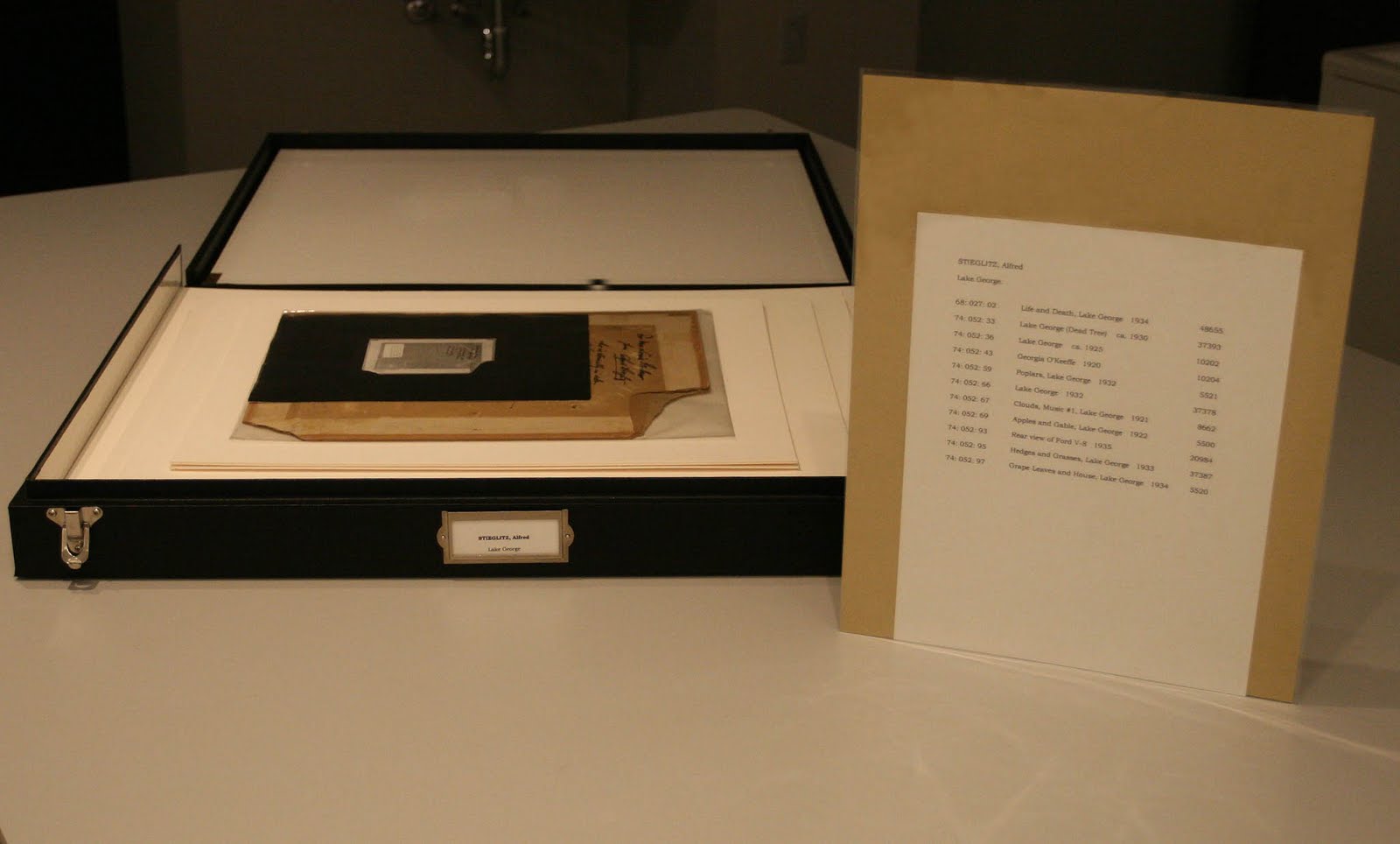
Another of the main attractions of the day which made an indelible imprint in our memory: the case with 11 original vintage copies of photographs made by Alfred Stieglitz: Life and Death, Lake George (1934); Lake George Dead Tree (1930); Lake George (1925); Georgia O´Keeffe (1921); Apples and Gable, Lake George (1922); Rear view of Ford V-8 (1935); Hedges and Grasses, Lake George (1933) and Grape Leaves and House, Lake George (1934).

These works belong to his last years of images creation, in which Alfred Stieglitz almost exclusively photographed Lake George trees - his state home - with whom he identified, together with the surrounding clouds and skies that he deeply studied for a lot of hours, something which happened above all from 1923, with his mother´s demise and his daughter´s mental illness.

Albeit this was a stage in which he greatly chose not to see his works repproduced in illustrated magazines - different from what he had made during the first two decades of XX Century, one can perfectly appreciate in these flawless copies that Stieglitz went on being very exacting (specially with himself) in regard to the quality of negatives and their printing on photographic paper, scopes in which he reached international renown thanks to the extraordinary quality of reproduction of his legendary Camera Work publication,


probably the best photography magazine of all time, which existed between 1903 and 1917.

On watching Poplars, Lake George (1932) from a very short range, it dawned on us in a very lively way that the masterful allegoric visual language used by A. Stieglitz in symbiosis with a deep artistic and personal introspection when relating Lake George poplars, high trees featuring delicateness and a limited lifespan, with the perishable nature of human existence, including his own life, which began weakening. He was already almost seventy years old and he had seen these same trees grow up and getting old during the long seasons he spent in Lake George, in the Adirondack Mountains, on the Northeast of New York, where his father had bought the family mansion in 1886.

Sublime photography at its best, in which the key factors are the person behind the camera, to be in the appropriate place and moment, the quality and direction of the light, the accuracy in the timing on pressing the shutter release button, the fight to try capturing the special and shortlived atmosphere of the moment and of course the photographer´s experience.

It´s not necessary to use top of the range cameras or the most professional lenses to get good pictures, something proved for decades by many world class photographers like Ian Berry (who started his career with a medium format 2 1/4 x 2 1/4 inch -6 x 6 cm- analog Zeiss Ikon Ikonta B 521/16 camera) and David Alan Harvey (who made great reportages for National Geographic using digital Nikons D70 and 100D - along with very good portraits made within very short distances for his series on Hip Hop music-) to name a few, though it isn´t less true that specific cameras and lenses feature different qualities, as happens for instance with Alex Soth and his 8 x 10 " (20 x 28 cm) large format Ebony SV810 camera with Nikkor W-300 mm f/5.6 and Copal 3 shutter, since when the camera turns into a real working tool and the photographer feels comfortable and identified with it, it´s possible to alter the way in which the world is seen, because besides, it is not the same what is attained with a large format 300 mm lens as what you get with an equivalent focal length lens in other formats.

Alfred Stieglitz began devoting intensively to the creation of pictures of trees precisely in 1932 (although he had already made his premonitory photograph Dead Tree in 1930, also in the surroundings of his family mansion ), and since then he photographed them in Lake George area from every distance and under different atmospheric and luminous conditions, something rather tangible in several of the 11 copies of Lake George series that we could see.


In spite of the perceptible grain in these amazing vintage copies on baryta paper and the usually simply acceptable quality of the lenses coupled to the cameras of the time, it doesn´t matter whatsoever when we speak about great images created by Alfred Stieglitz and many other eminent photographers who implemented their labour between 1890 and the II World War.


The emotional intensity reached indescribable peaks when after having shown us the aformentioned works by Eugene Smith, Lewis Hine and Alfred Stieglitz, Joe Struble told us that the moment had arrived to watch vintage copies of pictures made by Julia Margaret Cameron, manufactured through the albumen technique, making direct contacts from huge glass plates in sizes around 20 x 25 cm and 30 x 40 cm with a humid collodion emulsion.

Impossible to explain these moments with words. Suddenly, Joe Struble appeared with another more of the large rectangular cases, containing 9 works by the great British portrait photographer who developed her production of pictures between 1863 and 1876.


With great care and accuracy, Joe Struble, currently one of the greatest experts in the world in this sphere, is spreading out on the table the vintage copies of pictures taken by Julia Margaret Cameron, in which once more it´s distinctly revealed that the search for technical perfection was not her priority, that was essentially focused on the inception of images unmistakably unveiling the emotional state of the persons she photographed, both when they were famous men and very specially on taking pictures of women, whom she made pose with their hair loose.

Margaret Cameron´s photographs feature a romantic character, making use of subdued light and dark backgrounds to beget oniric contexts by the minute.

During her three first years of photographic yield between 1863 and 1865, Julia Margaret Cameron availed herself of a trial and error method through which she unfolded her particular technical and aesthetic grasp of photography, using a large format camera fed by 9 x 11 inches (23 x 28 cm) glass plates, overly big for the second hand Jamin Darlot Cone Centralisateur 12" (305 mm) lens and a diaphragm f/5, f/6 or f/7 (a French variation of the Petzval optical design and a viewing field similar to the one rendered by a 135 mm lens in full frame 35 mm format) attached to the box.

This objective offered exposure times between approximately 4 and 7 minutes in studio, depending on the existing luminosity, and it delivered very good sharpness in the center at normal and long distances on a narrow image field of around 35º, with noticeable curvature of field and astigmatism beyond those limits, also suffering from strong chromatic aberration, traits that made unfeasable both the depth of field control and the attainment of sharp images with an accurate focus at the very short distances which were the ones mostly used by the British photographer in her portraits (she always stroved after approaching the camera with its lens as much as possible to the head of the person posing sitting, in order that it filled the whole frame), so a high percentage of her pictures appear partially out of focus and slightly moved, for it was very difficult to get the portrayed people stay put during so many minutes of exposure, with the camera on a tripod.

Therefore, they´re portraits greatly taking advantage of the significant curvature of field and the progressive fall-off towards the image borders inherent to the Petzval optical design, which helped and helps set the attention of the observers of each photograph on the center of the image, without forgetting that the intentional design ´defects´ inserted in the optical formula of the lens, in singular synergy with its too small coverage for the size of large format glass plate it used, turn out to be decisive for the creation of uncommon portraits featuring high doses of bokeh by means of these vintage lenses made in brass, which even today go on being used by some enthusiasts of the old objectives wishing to achieve the very special Petzval image aesthetics in their pictures, besides being able to get at will an outstanding soft focus in the portraits.

The nine albumen vintage copies of Julia Margaret Cameron pictures we could see and appreciate in our hands (Beatrice, The Mountain Sweet Liberty, Mrs Herbert Duckworth (Julia Jackson), Sappho, Ophelia Study nº 2, La Madonna, Rosalba, Mrs Herbert Duckworth, and Mary Mother) were made in 1866 and 1867 with a Dallmeyer Rapid Rectilinear 30" (762 mm) f/8 lens designed to cover 18 x 22 inches (45.72 x 55. 88 cm) glass plates, but it was used by Julia Margaret Cameron attached to a large format camera using 12 x 15 inches (30.48 x 37.2 cm).

In this Dallmeyer Rapid Rectilinear 30" f/8 lens, the aberrations were much better corrected, enabling a higher control of the diaphragm aperture and depth of field, as well as being able to synergize with bigger glass plates than the ones used by the British photographer during the first three years of her career, it all with the added bonus that the optical genius John Henry Dallmeyer was also an accomplished artisan whose lenses (among the best in the photographic market between 1860 and 1900 regarding optical and mechanical quality) sported a further specially valuable trait: its remarkable consistency in results, since they were with difference the ones featuring fewer variations unit by unit, clearly beating in this side the lenses from other brands.


Whatever it may be, the debate on the pictorialist effects and the use of soft focus by Julia Margaret Cameron keeps on wholly latent, because one of the most important virtues of the glass plates with collodion is that they can yield very crisp and detailed images, albeit it isn´t less true that the British photographer managed to attain the kind of photos she wished through her then innovative and unconventional method, different from the one used by the photographers of her time.


We watch in wonderment the proficiency of Joa Struble, a great and experienced professional, making us hark back in time to the historical context around middle of XIX Century, at the height of the European Industrial Revolution, approximately 25 years after the discovery of photosensitive materials by Niepce and Daguerre. They are moments in which the albumen prints have become the first commercially viable method to make a photographic copy printed on a paper base from a negative.

This revolutionary technique for the time consisted in coating a usually 100% cotton photographic paper with an emulsion of white of egg albumen and sodium or amonic chloride, all of which was left to dry, and after it, the photographic chemicals remained fixed to the paper on which the printing was made, bringing about a slightly glossy surface on which the sensitizer rested.


It´s a hugely complex printing method and it requires great accuracy, since any little error during the making or development of the negative can affect both the appearance of the final picture and its stability and durability of the negative.


It wasn´t easy to avoid a certain trembling and quivering on holding between our hands these original albumen vintage copies made by Julia Margaret Cameron, fairly exotic, because they´re actually printed photographs more than developed, since they were born as a direct result of exposure to the light, without the help of any sort of developing solution.

On the other hand, the labour of George Eastman House Museum with regard to the preservation of these albumen vintage copies is specially praiseworthy, because they crack easily with the most feeble humidity ( owing to internal stress and hysteresis generating that the albumen layer swells and shrinks much more than most materials) and even with a very superficial cleaning, so maximum cares and safekeeping protocols are carried out.

But the Institution has got some of the most learned pundits in the world on this subject, both regarding the knowledge of the historical evolution of albumen prints of photographs made by Julia Margaret Cameron, Gustave Le Gray, Edward Muybridge, etc, and the current making of albumen copies, without forgetting other types of fascinating old procedures of printing (daguerrotypes, platinotypes, carbon printing, etc) like Mark Osterman (Historian of Classic Photographic Procedures, Director of the Kay R. Whitmore Preservation Center of the George Eastman House Museum and top authority in the domain of photography with collodion, and a consummate expert and researcher on all kind of old photographic systems, from Niepce heliographs to silver gelatin emulsions, different ways to create a passepartout on glass, use of Camera Lucida and Physionotrace, etc), France Scully Osterman (another great specialist in both photography with collodion and a wide assortment of old photographic procedures, who in the same way as Mark Osterman has developed a laudable work of teaching in the Workshops of Old Historical Photographic Procedures imparted in the George Eastman House Museum), Mark Robinson (top authority in the field of daguerreotypes , who currently uses this photographic technique in his works, achieving results which are quite up to the standard of quality of the best XIX Century artists of the daguerreotype. He works in Toronto, Canada, and gives classes and lectures on old photographic systems at Ryerson University and at the George Eastman House Museum, also being a remarkable albumen printer and current President of the Daguerre Society), Grant B. Romer (Co-Director of the Advanced Residency Program in Photograph Conservation of the George Eastman House, another world class specialist in daguerreotypes, being an outstanding consultor and curator for dealers, collectors and institutions worldwide, having been the establisher of the current conservation laboratory at the GEH since 1978), James M. Reilly (Professor of the Rochester Institute of Technology and Director of its Image Permanence Institute, also being Co-Director of the Advanced Residency Program in Photograph Conservation of the George Eastman House), Gary Albright (GEH photographic conservator featuring a 32 years experience, having also worked at the Northeast Document Conservation Center in Andover, Massachussets) David Wooters (Archivist of the Photography Collection), Ryan Boatright ( Staff Scientist at the Image Permanence Institute of the Rochester Institute of Technology, and has imparted courses on the identification and dating of all the major photographic print systems), Bryant McIntyre (using the Leo 982 scanning electron microscope with energy dispersive X-Ray spectroscope and magnifications up to x 50,000) along with other great scholars who made a great labor at the GEH like Alice Swan ( with outstanding research made during seventies on the deterioration of daguerreotypes, treatments of conservation for photographs and very in-depth investigation on French methods and materials for colouring daguerreotypes, and while studying a famous daguerreotype image of Emily Dickinson, she managed to discover some vestiges of previous coloring on Dickinson´s forehead, on the pin and on the flowers appearing on it ), Rachel Stuhlman (Curator of Rare Books and an authority on photographically illustrated editions), Dr Fenella G. France (mastering the use of humidity detector sheets), etc, without forgetting very prominent Fellows of the Advanced Residency Program in Photograph Conservation like Ralph Wiegandt ( he was the Conservator of the Rochester Museum and Science Center in Rochester, New York and the Henry Ford Museum & Grrenfield Village in Dearborn, Michigan, featuring a great expertise in both all aspects of collection care and the conservation of functional objects and scientific instruments), Fernanda Valverde (one of the most important authorities in the world on nitrate cinematographic films), Elena Simonova-Bulat (Photograph Conservator for the Mellon Photograph Preservation Programme at Havrard University Library and a pundit on the Hermitage´s daguerreotype collection), Katharine Whitman ( Photograph Conservator for the Art Gallery of Ontario, in Toronto, Canada, who has made very comprehensive research on the history and conservation of the glass supported photographs, and she was also the driving force in the investigation and conservation of a highly valuable gelatine silver interpositive glass of Abraham Lincoln printed by George B. Ayres, which was originally taken in 1860 by Alexander Hesler in Chicago, Illinois), Rosina Herrera (an expert on both paper and photograph conservation, having attended to courses given by Angel Fuentes in Spain and Ian and Angela Moor in England), Lene Grinde ( who has developed a number of restoration methods for water damaged photographic material) , and many others.


The Gannett Foundation Photographic Study Center of the George Eastman House Museum of Photography and Film in Rochester makes a point of fostering the restauration of originals and a first-rate photographic retouching. In this image, we can see some black and white vintage gelatin silver prints, made in Rochester area during thirties, ready to be retouched.


Instants before the good-bye, the great specialist on History of Photography Joe Struble poses by two photographs made by Julia Margaret Cameron and printed on albumen paper.

viernes, 24 de junio de 2011

CENTRO DE ESTUDIOS FOTOGRÁFICOS DE LA FUNDACIÓN GANNETT DEL GEORGE EASTMAN HOUSE MUSEUM OF PHOTOGRAPHY AND FILM IN ROCHESTER : RECUERDOS DE UNA JORNADA CON EUGENE SMITH, LEWIS HINE, A. STIEGLITZ Y JULIA MARGARET CAMERON

Texto y Fotos: José Manuel Serrano Esparza. LHSA
ENGLISH VERSION


Amablemente atendidos por Joe Struble, Assistant Archivist del Museo Internacional George Eastman House of Photography and Film de Rochester (Nueva York) , elrectanguloenlamano.blogspot.com tuvo ocasión de ver y palpar in situ una amplia gama de copias vintage originales de muy alta calidad de imágenes creadas por cuatro grandes de la Historia de la Fotografía Mundial: Eugene Smith, Lewis Hine, Alfred Stieglitz y Julia Margaret Cameron.


El encuentro tuvo lugar en el interior del Centro de Estudios Fotográficos de la Fundación Gannet (una de las joyas de la corona del George Eastman House Museum, el más importante sancta sanctorum de la Historia de la Fotografía existente en el mundo junto con el ICP de Nueva York), que alberga una excelente selección de obras de muchos fotógrafos de talla universal de todos los tiempos, guardadas y preservadas con el mayor de los esmeros en grandes estuches especiales rectangulares diseñados a tal efecto, incluyendo cada uno de ellos copias artesanales sobre papel fotográfico baritado realizadas en cuarto oscuro con enormes niveles de meticulosidad y muchas horas de duro trabajo, complementadas por abundante experiencia, buen gusto y amor por las cosas bien hechas.


Joe Struble distribuyendo sobre la mesa con gran cuidado varias copias realizadas por el propio Eugene Smith y correspondientes a su famosa serie titulada
A Spanish Village, que realizó en el pueblo extremeño de Deleitosa en 1950.


El aspecto de cada uno de los preciosos estuches rectangulares color negro mate que incluyen auténticas obras maestras es simplemente soberbio: se hallan en un perfecto estado de conservación, prácticamente como nuevos, y las charnelas que permiten su apertura y cierre no presentan el más mínimo arañazo. Ni que decir tiene que todos y cada uno de los estuches llevan en la parte central de su lomo el nombre del fotógrafo autor de las fotos que hay en su interior, tal y como ocurrió con éste titulado W. Eugene Smith: Spanish Village, que fue el primero que nos mostró Joe Struble, y en cuyo interior había seis fotografías correspondientes a su reportaje "A Spanish Village" que llevó a cabo en el pueblo de Deleitosa (Cáceres) en 1951, y donde fue mucho más allá de realizar un exhaustivo ensayo fotográfico con 1.575 fotografías, redactando además un informe de 24 páginas con información sobre la España del momento y haciendo un notable trabajo de investigación social apuntando los nombres y edades de todas las personas entrevistadas y consiguiendo una cierta empatía con las personas fotografiadas, además de efectuar un profundo análisis socioeconómico sobre las duras condiciones de trabajo de la posguerra en España, los elevados índices de analfabetismo,
la frecuente ausencia de condiciones sanitarias adecuadas, etc.

El reportaje "Un Pueblo Español", publicado por la revista Life en un número especial en el que se incluyeron 17 fotografías hechas por Eugene Smith en Deleitosa, fue un éxito sin precedentes en la historia de dicha publicación, vendiéndose más de 22 millones de ejemplares entre el número original y las posteriores reediciones.


Copia vintage de impresionante calidad realizada por Eugene Smith sobre papel baritado a partir del negativo de una de sus más famosas imágenes: Muerte en un Pueblo Español, que plasma el velatorio de Juan Larra, impresionado en Deleitosa (Cáceres).

Es una fotografía sobrecogedora, en la que se percibe muy claramente que el Genio de Wichita pasó muchísimas horas en cuarto oscuro, luchando denodadamente por generar una partitura visual que evocara con la mayor fidelidad posible el momento de la creación de la imagen.

Eugene Smith, además de ser un grandísimo fotógrafo, era un extraordinario laboratorista, que frecuentemente se recluía durante días, trabajando hasta el agotamiento, hasta conseguir la copia que quería, y el standard cualitativo que siempre buscó puso en jaque incluso a las mejores publicaciones ilustradas del mundo durante los años cuarenta, cincuenta, sesenta y setenta, incluyendo a la mismísima
Life

José Manuel Serrano Esparza en el interior de la Gannet Foundation del George Eastman House Photography Museum, con varias de las copias vintage sobre papel baritado del mítico reportaje realizado por Eugene Smith en Deleitosa (Cáceres) en 1951. 

Otra imagen de la mesa sobre la que aparece el estuche negro rectangular protector y junto a él cinco de las seis copias vintage que contiene, realizadas por el propio Eugene Smith y pertenecientes a su mítico ensayo fotográfico en Deleitosa (1951): Después de un Día de Trabajo (todavía en el interior del estuche), Deleitosa (España), El Trabajo de Una Mujer Joven, La Hilandera, Muerte en un Pueblo Español, y Mujer Española.

Nos impresionó especialmente la fabulosa copia de Mujer Española, en la que aparece una anciana de Deleitosa envuelta en un ropaje negro que cubre todo su cuerpo, con excepción de la nariz, pómulos, cejas y frente, apreciándose en el borde superior derecho del fotograma, de perfil, dos tercios del rostro y la zona superior del pecho de un hombre.

Es una imagen de gran impacto, con muy fuertes contrastes dominados por el amplio y potente haz de luz solar muy dura que ilumina parte de la pared tras la anciana - así como la totalidad de su rostro y ropaje-, el color oscuro y pliegues de su indumentaria y la gran franja vertical del tercio izquierdo de la imagen. 

Exquisito el trabajo de cuarto oscuro de Eugene Smith, consiguiendo mantener detalle tanto en las zonas high key de enorme potencia como en las sombras acentuadas, algo que tiene un gran mérito, ya que las altas luces y negros profundos existentes en el momento en que fue realizada esta fotografía por Eugene Smith en Deleitosa son todavía de mayor intensidad que en las extraordinarias imágenes de Manuel Alvarez Bravo Retrato de lo Eterno (1935), Los Agachados (1934), e incluso que en Tumba Reciente (1933).


Estuche rectangular con un amplio surtido de fotografías realizadas por Lewis Hine entre 1930 y 1931 y correspondientes a su célebre reportaje sobre la construcción del Empire State Building de Nueva York. Esta vez se trataba de los contactos tal cual, creados a partir de los negativos originales expuestos con su cámara de gran formato Graflex de 5 " x 7 " (negativo de 13 x 18 cm) , por lo que la calidad de imagen, sobre todo en lo tocante a nivel de detalle y gama tonal era espléndida. No en vano, durante los años treinta, la mayor parte de las fotografías de Lewis Hine publicadas fueron impresas utilizando los mencionados negativos originales de gran formato que permitían unos excepcionales niveles cualitativos de reproducción en las revistas gráficas ilustradas de la época.

Quizá el ejemplo más representativo de ésto fue Margaret Bourke-White, con sus excelentes reportajes industriales de gran formato en Magnitogorsk (URSS) en 1931, la presa de Fort Peck (portada del primer número de
Life en 1936), etc, sin olvidar que en buena medida, probablemente el fotógrafo que sacó más partido a la para entonces destacada libertad de movimientos disparando a pulso que permitía la cámara Graflex había sido Alfred Stieglitz en 1925 durante la realización de su serie Equivalents, con un modelo de esta marca en formato 4 x 5" (10 x 12 cm) que le permitió apuntar directamente al cielo liberándose de la servidumbre del trípode y fotografiar con rapidez las nubes de Lake George en los momentos muy concretos y fugaces que deseaba plasmar.

Ya treinta y tres años antes, Stieglitz había utilizado una cámara de gran formato Folmer & Schwing que utilizaba placas de vidrio de 4 x 5" (10 x 12 cm) -que a diferencia de su cámara de 8 x 10 " (20 x 25 cm), no precisaba utilizar un robusto trípode- y hacía posible disparar a pulso, con la que hizo en pleno invierno de 1892 dos de sus más famosas fotografías:
The Terminal y Fifth Avenue.

La contemplación de estos contactos de gran formato de Lewis Hine enmarcados por paspartús fue una experiencia verdaderamente única e inolvidable.


Estuche rectangular abierto en posición horizontal con contactos vintage de gran formato del reportaje sobre la construcción del
Empire State Building realizado por Lewis Hine entre 1930 y 1931. 

A la derecha se hallan muchas fotografías pertenecientes a esta mítica serie, mientras que a la izquierda hay adherida una hoja con información detallada sobre cada una de las imágenes, año y lugar de captación, tamaño de la copia, etc. 

La primera imagen que se aprecia es la famosa fotografía del Empire State Building tomada desde la confluencia de la E34 Street con Madison Avenue, en la que se ve el gran rascacielos al fondo, mientras una farola de notable tamaño surge del borde inferior izquierdo del fotograma y se eleva hasta casi tocar su límite superior, y la mayoría de coches de época y transeúntes aparecen trepidados debido a la baja velocidad de obturación.


Nada menos que 16 contactos vintage realizados a partir de negativos originales de gran formato 5" x 7 " (13 x 18 cm), puestos sobre una de las mesas en el interior de la Gannet Foundation del Eastman Kodak Museum of Photography en Rochester.

Cada uno de ellos lleva su correspondiente paspartú así como un papel especial transparente de protección.

A diferencia de las cámaras de gran formato anteriores, que precisaban que el fotógrafo realizara la composición y el enfoque antes de introducir la placa fotosensible, la Graflex de gran formato 5 " x 7 " (13 x 18 cm) aparecida durante la primera década del siglo XX y utilizada por Lewis Hine, Dorothea Lange y otros fotógrafos, permitía una mucho mayor precisión de encuadre hasta los mismos bordes de la placa, así como posponer las decisiones con respecto a punto de enfoque y ángulo de visión hasta el mismo instante de presionar el botón liberador del obturador, con lo que los márgenes de seguridad a la hora de conocer con exactitud lo que aparecería finalmente dentro de los negativos de gran superficie eran bastante superiores.


Otro de los platos fuertes del día y que dejó una huella indeleble en nuestra memoria: el estuche con 11 copias vintage originales de fotografías del Maestro Alfred Stieglitz:
Life and Death, Lake George (1934); Lake George Dead Tree (1930); Lake George (1925); Georgia O´Keeffe (1920); Poplars in Lake George (1932); Lake George (1932); Clouds, Music 1. Lake George (1921); Apples and Gable, Lake George (1922) ; Rear view of Ford V-8 (1935); Hedges and Grasses, Lake George (1933) y Grape Leaves and House, Lake George (1934).

Estas obras pertenecen a sus últimos años de creación de imágenes, en los que Alfred Stieglitz fotografió casi exclusivamente los árboles de Lake George - su mansión familiar- con los que se identificaba, así como las nubes y cielos circundantes, que estudió en profundidad durante muchísimas horas, algo que tuvo lugar sobre todo a partir de 1923, con la muerte de su madre y la enfermedad mental de su hija .

Aunque ésta fue una etapa en la que optó en gran medida por no ver su obra reproducida en revistas gráficas, a diferencia de lo que había hecho durante las dos primeras décadas del siglo XX, se aprecia perfectamente en estas copias de impecable realizació que Stieglitz seguía siendo muy exigente - especialmente consigo mismo- en la calidad de los negativos y su positivado sobre papel fotográfico, aspectos en los que alcanzó celebridad mundial gracias a la extraordinaria calidad de reproducción fotográfica de su legendaria publicación Camera Work,


probablemente la mejor revista de fotografía de todos los tiempos, que circuló entre 1903 y 1917. 

Al contemplar desde muy corta distancia Poplars, Lake George (1932) pudimos constatar de manera muy vívida el magistral lenguaje visual alegórico en simbiosis con una profunda meditación artística y personal utilizada por A. Stieglitz a la hora de vincular los álamos de Lake George, árboles delicados, de gran altura y vida limitada, con el carácter perecedero de la existencia humana, incluyendo la suya propia, que comenzaba a debilitarse. Tenía ya casi 70 años, y durante muchas décadas había visto crecer y también envejecer a estos mismos árboles durante las largas temporadas que pasaba en Lake George.

Fotografía sublime, en estado puro, en la que los factores más importantes son la persona que se halla tras la cámara, estar en el lugar y momento adecuados, la calidad y dirección de la luz, la precisión en el timing al apretar el botón liberador del obturador, la lucha por tratar de captar la especial y efímera atmósfera del momento y por supuesto la experiencia.

No es necesario utilizar las cámaras de gama más alta ni las ópticas más profesionales para conseguir buenas fotografías, algo demostrado diacrónicamente por grandes de la fotografía mundial como Ian Berry (que comenzó su carrera con una Zeiss Ikon Ikonta B 521/16 analógica de formato medio 6 x 6 cm), David Alan Harvey (que hizo excelentes reportajes para National Geographic con Nikons D70 y D100 digitales -así como muy buenos retratos intimistas desde distancias muy cortas en su serie sobre música Hip Hop), y muchos otros, siendo no menos cierto que las cámaras y objetivos específicos poseen cualidades diferentes, tal como sucede por ejemplo con Alex Soth y su Ebony SV810 de gran formato 8 x 10 " (20 x 25 cm) con objetivo Nikkor W-300 mm f/5.6 y obturador Copal 3, ya que cuando la cámara se transforma en auténtica herramienta de trabajo y el fotógrafo se siente a gusto e identificado con ella, se puede alterar el modo en que se ve el mundo, porque además no es lo mismo lo obtenido por un objetivo de 300 mm de gran formato que lo que se consigue con una óptica de focal equivalente en otros formatos.

Alfred Stieglitz comenzó a dedicarse intensivamente a la obtención de imágenes de árboles precisamente en 1932 (aunque ya había realizado su premonitoria fotografía Dead Tree en 1930, también en las proximidades de su mansión familiar), y desde entonces los fotografió en el área de Lake George desde todo tipo de distancias y condiciones atmosféricas y luminosas diferentes, algo muy tangible en varias de las 11 copias de la serie Lake George que pudimos apreciar.


Las cámaras de gran formato 8 x 10 (20 x 25 cm), Folmer & Schwing 4 x 5 " (10 x 12 cm) y Graflex 4 x 5 " (10 x 12 cm) utilizadas por Alfred Stieglitz le permitieron conseguir unos sensacionales niveles de poder de resolución y amplitud de gama tonal en sus fotografías de blanco y negro, realzados magistralmente con sublimes impresiones en platino y paladio, además de experimentar con objetivos de enfoque suave, distintos contextos atmosféricos y una composición meticulosa.  


La intensidad emocional alcanzó cotas indescriptibles cuando tras habernos mostrado las anteriormente comentadas obras de Eugene Smith, Lewis Hine y Alfred Stieglitz, Joe Struble nos indicó que había llegado el momento de ver copias vintage de Julia Margaret Cameron elaboradas mediante la técnica del positivado a la albúmina, realizando contactos directos a partir de enormes placas de vidrio tamaño 20 x 25 cm y 30 x 40 cm con una emulsión de colodión húmedo.


Imposible describir con palabras estos momentos. 

Joe Struble apareció de repente con otro más de los grandes estuches rectangulares, que contenía 9 obras de la gran retratista británica que desarrolló su producción fotográfica entre 1863 y 1876.


Con gran cuidado y precisión, Joe Struble, hoy por hoy uno de los mayores expertos del mundo en este ámbito, va desplegando sobre la mesa las copias vintage de fotografías de Julia Margaret Cameron, en las que una vez más se revela claramente que la búsqueda de la perfección técnica no era su prioridad, que radicaba esencialmente en la creación de imágenes que mostraran de modo inequívoco el estado emocional de las personas a las que retrataba, tanto cuando se trataba de hombres famosos como muy especialmente al fotografiar mujeres, a las que hacía posar con el pelo suelto.

Las fotografías de Margaret Cameron son de índole romántica, utilizando luz tenue y fondos oscuros para crear contextos por momentos oníricos.

Durante sus tres primeros años de producción entre 1863 y 1865, Julia Margaret Cameron se sirvió de un método de prueba y error mediante el que desarrolló su especial concepción técnica y estética de la fotografía, utilizando una cámara de gran formato que usaba placas de vidrio de 9 x 11 pulgadas (23 x 28 cm), excesivamente grandes para su objetivo de segunda mano fabricado a finales de la década de los años 1850s Jamin Darlot Cone Centralisateur de 12 pulgadas (305 mm) y un diafragma f/5, f/6 o f/7 (variación francesa del diseño óptico Petzval y un campo de visión similar al de un objetivo de 135 mm en formato full frame 35 mm).

Este objetivo ofrecía rangos de exposición entre aproximadamente 4 y 7 minutos en estudio, dependiendo de la luminosidad existente, y lograba muy buena definición en el centro a distancias normales y largas sobre un estrecho campo de imagen de aproximadamente 35º, con apreciable curvatura de campo y astigmatismo más allá de dichos límites, adoleciendo además de fuerte aberración cromática, y hacía inviable tanto el control de la profundidad de campo como la consecución de imágenes nítidas con enfoque preciso a las distancias muy cortas que eran las mayormente utilizadas por la fotógrafa británica en sus retratos (siempre intentaba acercar la cámara con su objetivo lo más posible a la cabeza de la persona que posaba sentada, a fin de que la testa llenara todo el encuadre), por lo que un elevado porcentaje de sus fotografías aparecen parcialmente desenfocadas y ligeramente movidas, ya que era muy difícil conseguir que las personas retratadas estuvieran totalmente estáticas durante tantos minutos de exposición con la cámara sobre un trípode.

Son pues retratos que se benefician notablemente de la importante curvatura de campo y el progresivo viñeteado hacia los bordes de imagen inherentes al diseño Petzval, que ayudaba y sigue ayudando a fijar en el centro de la imagen la atención de los observadores de cada fotografía, sin olvidar que los "defectos" de diseño intencionados introducidos en la fórmula óptica del objetivo, en peculiar sinergia con su demasiado pequeña cobertura para el tamaño de placa de vidrio de gran formato que utilizaba, resultan decisivos para la creación de retratos únicos con grandes dosis de bokeh mediante estos objetivos vintage realizados en latón, que incluso hoy en día siguen siendo utlizados por algunos entusiastas de las ópticas antiguas que desean conseguir la muy especial estética de imagen Petzval en sus fotografías, pudiendo lograr además, si así se desea, una notable suavidad de enfoque en los retratos.

Las nueve copias vintage a la albúmina de Julia Margaret Cameron que pudimos ver y apreciar en mano ( Beatrice, The Mountain Nymph Sweet Liberty, Mrs Herbert Duckworth (Julia Jackson), Sappho, Ophelia Study nº 2, La Madonna, Rosalba, Mrs Herbert Duckworth y Mary Mother) fueron hechas en 1866 y 1867 con un objetivo Dallmeyer Rapid Rectilinear de 30 pulgadas (762 mm) f/8, diseñado para cobertura de placas de vidrio de 18 x 22 pulgadas (45.72 x 55.88 cm), pero que fue utilizado por Julia Margaret Cameron conectado a una cámara de gran formato que utilizaba placas de 12 x 15 pulgadas (30.48 x 37.2 cm).

En este objetivo Dallmeyer Rapid Rectilinear 30" f/8, las aberraciones estaban mucho mejor corregidas, permitiendo un mayor control de la apertura de diafragma y la profundidad de campo, además de ser capaz de sinergizar con placas de vidrio más grandes que las utilizadas por la fotógrafa británica durante los tres primeros años de su carrera, todo ello con la ventaja añadida de que el genio óptico anglo-alemán John Henry Dallmeyer era demás un consumado artesano manual, cuyos objetivos además de ser en gran medida los de mayor calidad óptica y mecánica existentes en el mercado fotográfico entre 1860 y 1870, poseían otra cualidad especialmente valiosa: su relevante consistencia en resultados, ya que eran con diferencia los que presentaban menos variaciones unidad por unidad, superando claramente en esta faceta a las ópticas de otras marcas.

Sea como fuere, el debate sobre los efectos pictorialistas y el uso de los desenfoques por parte de Julia Margaret Cameron prosigue plenamente latente, ya que al fin y al cabo, las placas de vidrio con colodión pueden producir imágenes de gran claridad y nivel de detalle, aunque no es menos cierto que la fotógrafa británica consiguió el tipo de fotos que deseaba con su método por entonces innovador y poco convencional, diferente al de los fotógrafos de su época


Contemplamos con asombro y admiración el buen hacer de este gran profesional que es Joe Struble, que hace que retrocedamos aproximadamente 140 años en el tiempo, al contexto histórico de mediados del siglo XIX, en plena Revolución Industrial Europea, aproximadamente 25 años después del descubrimiento de los materiales fotosensibles por Niepce y Daguerre. 

Son momentos en los que las copias a la albúmina se han convertido en la nueva tecnología fotográfica, ya que se trata del primer método comercialmente viable de producir una copia fotográfica impresa sobre una base de papel a partir de un negativo.

Esta por entonces revolucionaria técnica consistía en recubrir con una emulsión de albúmina de clara de huevo y cloruro sódico o amónico un papel fotográfico generalmente 100% algodón, que después se dejaba secar, tras lo cual los químicos fotográficos quedaban unidos al papel sobre el que se realizaba la impresión, generándose una superficie ligeramente satinada sobre la que descansaba el sensibilizador.

Es un método de impresión enormemente complejo y que requiere gran precisión, ya que cualquier pequeño error en la fase de preparación o revelado del negativo puede afectar al aspecto de la fotografía final así como a la estabilidad y durabilidad del negativo.


No era fácil evitar un cierto temblor y estremecimiento al sujetar entre las manos esta copias vintage originales a la albúmina de obras realizadas por Julia Margaret Cameron, exóticas a más no poder, ya que se trata en realidad de fotografías impresas más que reveladas, al nacer las imágenes como resultado directo de la exposición a la luz, sin la ayuda de ningún tipo de solución de revelado.


Por otra parte, la labor del George Eastman House Museum con la preservación de estas copias vintage a la albúmina resulta especialmente encomiable, ya que se agrietan fácilmente con la más leve humedad -debido a stress interno e histéresis que hacen que la capa de albúmen se hinche y se contraiga bastante más que la mayoría de materiales- e incluso con una muy ligera limpieza, por lo que se llevan a cabo los máximos cuidados y protocolos de conservación y mantenimiento.

Pero la Institución cuenta con varios de los mayores expertos internacionales en esta materia, auténticas eminencias tanto en el conocimiento de la evolución histórica de las copias a la albúmina de Julia Margaret Cameron, Gustave Le Gray, Edward Muybridge, etc, como en la elaboración hoy en día de copias a la albúmina, sin olvidar otros tipos de fascinantes métodos antiguos de positivado (daguerrotipos, platinotipos, impresión al carbono, etc) como Mark Osterman (Historiador de Procesos Fotográficos Clásicos, Director del Centro de Conservación Kay R. Whitmore del George Eastman House Museum y máxima autoridad mundial en el ámbito de la fotografía con colodión, además de consumado experto e investigador en todo tipo de métodos fotográficos antiguos, desde heliografías de Niepce hasta emulsiones con gelatina de plata), France Scully Osterman (otra gran especialista en fotografía con colodión, así como en una amplia gama de sistemas fotográficos antiguos, al igual que Mark Osterman, ha desarrollado una meritoria labor de enseñanza en los Talleres de Procedimientos Fotográficos Históricos impartidos en el George Eastman House Museum), Mark Robinson (máximo especialista mundial en daguerrotipos, que utiliza hoy en día esta técnica fotográfica en sus obras, consiguiendo unos resultados que nada tienen que envidiar a los de los mejores artistas del daguerrotipo del siglo XIX). Trabaja en Toronto, Canadá, e imparte clases y conferencias sobre métodos fotográficos antiguos en la Universidad de Ryerson y el George Eastman House Museum. Es también un destacado positivador al albúmen y actual Presidente de la Sociedad Daguerre) y otros.


La restauración de originales y el retoque fotográfico de muy alta calidad es una de las disciplinas en las que se pone mayor énfasis en el Centro de Estudios Fotográficos de la Fundación Gannet del George Eastman House Museum of Photography and Film de Rochester. En esta imagen podemos ver varias copias vintage de blanco y negro al gelatinobromuro de plata y en distintos tamaños, realizadas en el área de Rochester durante los años treinta, listas para ser retocadas.


Momentos antes de la despedida, el gran especialista en Historia de la Fotografía Joe Struble posa junto a dos fotografías de Julia Margaret Cameron positivadas sobre papel con albúmina.


Copyright Texto y Fotos: José Manuel Serrano Esparza.