miércoles, 19 de mayo de 2010

CAPA AND THE REFUGEES OF CERRO MURIANO: LOCATION OF THE 9 PICTURES MADE ON SEPTEMBER 5,1936

SPANISH
Text and Indicated Photos: José Manuel Serrano Esparza. LHSA

elrectanguloenlamano.blogspot.com has been able to locate the exact place where Robert Capa made on September 5, 1936 in the area of Cerro Muriano an already known picture and three more ones unknown hitherto, which add to the discovery of the locations of the photographs of refugees made by Capa in this village of Córdoba province that we made in March 2008 and were published in Chapter 2 of our research on Robert Capa in Cerro Muriano, which makes up a total of nine pictures that we´ve been able to locate and that we explain in depth in the epigraph Definitive Location – included in the middle area of this article -, of which two (one in which can be seen two little children with handkerchiefs on their heads fleeing the Finca of Villa Alicia because the Francoist troops are already attacking the north side of Torreárboles hill and another one in which appears a woman mounting a donkey at approximately 700 meters from the north exit of Cerro Muriano village, taking her baby in arms and protecting it with an umbrella from sun beams, while she goes away from the village because of the increase of the Francoist aerial bombing of the village from around 15:00 h in the afternoon) didn´t have either  authorship or location known, since in the book The Spanish People´s Fight for Freedom written by Antonio Ramos Oliveira there isn´t any credit under them and any indication of the place where they were made, and after a strenuous effort of some years we have managed to discover both things. 


The key element for this finding has been a horizontal photograph which was included in the worldwide photographic exhibition This is War! Robert Capa at Work which was firstly held at ICP New York between September 26, 2007 and January 6, 2008 and subsequently in other venues of different countries, in which appears a father, his wife and their sons and daughters of different ages by the Cortijo of Villa Alicia, in Torrearboles area, and fleeing from the attack of the Francoist troops already taking place at that moment against the Republican forces defending the south area of this hill located approximately two kilometers in the southwest of Cerro Muriano.

It all has brought about in our viewpoint a significant advance as to the knowledge existing so far on the pictures made by Robert Capa on September 5, 1936, because some sources have been wrongly stating that there were four images of refugees made by them, when really, the photographs of refugees made by Capa in Cerro Muriano and known before these last findings made by elrectanguloenlamano were six.

But now, since April 9, 2010, we know that Robert Capa made a total figure of nine genuinely photojournalistic pictures, since they provide very abundant information, along with compromise in the photographers who captured them) which were taken between approximately 12:30 h at midday and 17:00 h in the afternoon, between the Cortijo of Villa Alicia, Cerro Muriano village, Obejo Train Station and El Vacar, on September 5, 1936, and whose exact spotting has been the fruit of many years of research by elrectanguloenlamano on one hand and Patricio Hidalgo Luque on the other, because during all of this time the working conditions have been very hard, with a scorching heat steadfastly present and the need of walking a lot of tens of kilometers until being able to find the exact locations in which Capa made each picture of refugees in Cerro Muriano area on September 5, 1936.


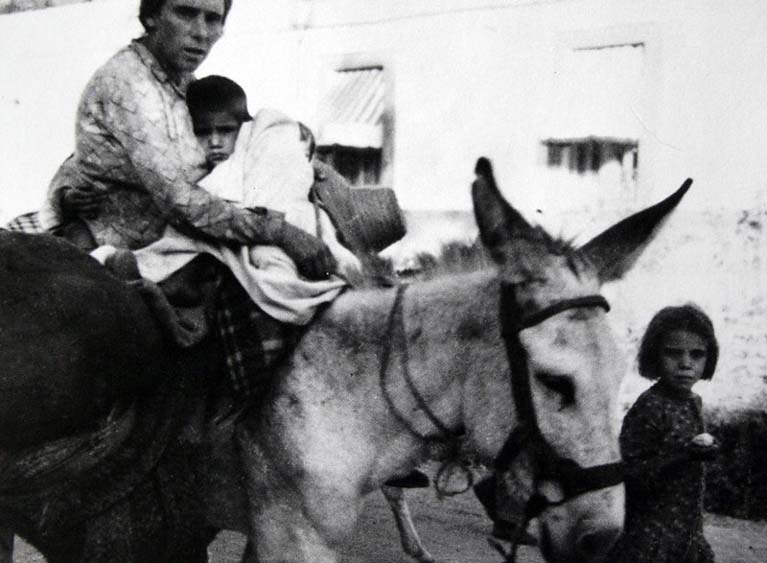
During the two first weeks of March of 2008, elrectanguloenlamano was in Cerro Muriano and could identify the exact location on which Robert Capa made four of his black and white pictures of refugees fleeing from this village on September 5th 1936 (one made in Cerro Muriano village, depicting a mother on a donkey and holding a little child wrapped in a white blanket while a little girl is on foot eating something which seems to be an apple, another picture of a woman walking between Cerro Muriano village and Obejo Train Station (with the village approximately 2 km behind her) on the way by the railway Cordoba-Almorchón with her right hand touching the right area of her chin, and holding a big improvised plaided baggage with her belongings and a telegraph post and some trees in the background, and one more depicting an old woman fleeing from Cerro Muriano village (approximately 2.5 km behind her) and walking towards Obejo Train Station, taking a baby in her arms (one of whose arms is visible hanging on the left side of the old woman´s waist, while on the left of the image we can see half of the body of a walking man wearing dark clothes, and another walking man on the right of the image, who is holding a big baggage on his head).

On the other hand, elrectanguloenlamano realized that another picture, the first one of the series of refugees on September 5th 1936, which was taken by Capa at midday (approximately at 12:30 h) had been made in the south of Cerro Muriano, because the skyline of the mountains visible in this vertical picture corresponds to Torrearboles (the highest hill of the north Sierra of Cordoba), a hypothesis also established by Patricio Hidalgo Luque, but this is a very big area, and it was not possible to find the exact location where Capa took this picture in which we can see a complete family fleeing from the combats that are already in march at that hour between attacking Francoist troops and Republican forces on the other side of Torrearboles hill. In this photograph, we can see a mature woman wearing dark clothes on the left (holding a baby in her arms), a little boy being approximately 7-9 years old, a mature man wearing black trousers, clear jacket and a hat and holding a little child between his arms (half of the face of the little child is in shadow and his right arm is supported on the right shoulder of the mature man) and in the background we can see a donkey on which there is a very little child.

elrectanguloenlamano.blogspot.com made comparison then and now colour pictures of all the aforementioned locations where Capa made the refugees pictures on September 5th 1936, in both Cerro Muriano area and in some stretches of the old railway line Cordoba-Almorchon between Cerro Muriano Village-Estacion de Obejo-El Vacar.

And I inscribed all of those colour pictures made by me and my research made during the two first weeks of March of 2008 in the Territorial Registry of the Intellectual Property of Madrid on March 17, 2008.

Two years later, on April 9th 2010, elrectanguloenlamano has been able to find, thanks to a lot of toil, sweat and above all luck, the exact locations where Robert Capa made three more unknown till now b & w photographs in Cerro Muriano area that must be added to the four already known, and besides, we could spot the exact location of the last picture of refugees made by Capa on a stretch of Cordoba crossing by the landscape known as Campo Alto, near El Vacar, what verified Patricio Hidalgo Luque´s - his is the main merit of the discovery of the location of this picture- hypothesis, though it was necessary to verify the spot with comparison then and now pictures to pass from hypothesis to reality.

THREE NEW PICTURES OF REFUGEES MADE BY CAPA AND UNKNOWN TILL NOW
Until now, we knew six pictures (not four as stated by some people) made by Capa to the refugees fleeing from Cerro Muriano area to save their lives on September 5th 1936: four of them appearing on page 1107 of the Vu magazine number 445 of September 23, 1936, and two further more (an horizontal one taken in a Cerro Muriano narrow street depicting a mother on a donkey with his child wrapped in a white blanket and a little girl standing by the animal and seemingly eating something, and a vertical one showing an old woman taking a baby in her arms - probably her grandson, whose right arm hangs under the old woman left arm- and hastily walking towards Obejo Train Station fleeing from Cerro Muriano, and with one man wearing dark garments on her left and another one wearing clearer attire on the right corner of the frame and taking a big baggage with his belongings on his head) of which there were some copies on b & w photographic paper that were preserved through decades by Cornell Capa, Edith Schwartz and Richard Whelan.

The new three pictures of refugees made by Capa on September 5th 1936 and unknown till now are the following ones:

Photo: Robert Capa. © ICP New York.

Photo: José Manuel Serrano Esparza

a) Photograph taken by Capa by the Cortijo of Villa Alicia, on the public way that passes next to it known as Public Way of Villa Alicia or Public Way of the Written Stone, with Torrearboles skyline visible in the background.

This is a horizontal picture, made at midday, and just after the first vertical picture (probably taken by Gerda Taro with her medium format 6 x 6 cm Rolleiflex as we´ll see later) of refugees fleeing from the Cortijo because they are already hearing the exchanges of fire between the trrops pf the left Francoist troops under the command of major Sagrado, who are attacking the south slope of Torreárboles and the Republican forces located on the crest of this hill.

We can see a tall man walking in the middle of two black donkeys. He wears dark trousers and jacket, white shirt and a hat. He seems to be the father of the children who appear behind him (a teenage girl just on his right, mounted on a donkey -wearing a black shirt, whose left sleeve is turned up-, a little child whose head protrudes from the left arm of the quoted young girl, a man in the far right background (hardly visible, mounted on a white donkey and wearing a cap with shade on his head), a little girl being approximately between 6-8 years old that is mounted on the black horse which is in the image just on the right of the tall man (she is wearing a clear jacket and dark shirt, while her hair is very tousled, her chin being partially hidden by the right tip of the black horse), and behind her, on the extreme left area of the photograph we can see a woman dressed with a dark garment, mounted on a white donkey and taking with her an absolutely lovely very little baby who has been captured by Robert Capa with all of his charm.

This photograph was unknown so far and was made by Robert Capa. There isn´t any doubt in this regard. The framing and composition are very typical in him, second nature and highly instinctive, adjusting the low area of the frame as much as possible to the nearest character to his camera, something which he would do once and again through his profesional career.

Seventy four years after Capa and Gerda Taro were in Cerro Muriano, the aforementioned second picture taken by Capa at midday in the south of Cerro Muriano with Torrearboles in the background (the horizontal one), an image unknown till the exhibition This is War! Robert Capa at Work held in New York, London, Milan, Barcelona and Rotterdam, has enabled elrectanguloenlamano to discover the exact location where these two pictures (the first vertical and the next one horizontal) were made: by the Cortijo of Villa Alicia, in the south area of Cerro Muriano, and approximately at a distance of 1,100 meters from the rotonda which links the CP-45 and the old N-432 Granada-Badajoz highway.

I do believe that all the men, women and children appearing in these two pictures taken by Robert Capa by the Cortijo of Villa Alicia with Torrearboles hill in the background, are members of the Zamora Lozano family.

Josefa Lozano and Rafael Lozano bought Villa Alicia in 1921, and it was subsequently improved by Miguel Zamora and Rafaela Lozano (who celebrated their Golden Anniversary in the Cortijo of Villa Alicia on January 6th 1986).

I´m convinced that all the people appearing in these two pictures made by Capa by the Cortijo of Villa Alicia are the members of the Zamora Lozano family on September 5, 1936, both grown up adults and little boys, girls and and babies.

Though 74 years have elapsed since Capa made these two pictures, I do believe that some of the persons photographed by Capa that midday of September 5th 1936 by the Cortijo of Villa Alicia could be still alive, being currently approximately between 74 and 90 years old.


b) At the same time, elrectanguloenlamano has found that this third picture which is on one of the pages of the illustrated book La Lucha del Pueblo Español por su Libertad, compiled by A. Ramos Oliveira and published in 1937 by the Press Department of the Spanish Embassy in London, was taken by Robert Capa also by the Cortijo of Villa Alicia, just beyond it, on the right, approximately at midday 12:30 h of September, 5, 1936.

In this black and white horizontal photograph, we can see two little children mounted on a donkey with the very clear profile of Torrearboles hill visible on the left of them in the background.

The elder brother child is holding the youngest one - sat on a pillow and with his naked right leg visible-. Both of the children are wearing pieces of white clothes probably knotted and put on their heads by the mother.

We can also glimpse the black beret and face in shadow of a man (he could be the father of both children) protruding over the pillow. Also discernible are a plaided blanket on the saddle on the left of the image and the right eye of the donkey on the right lower area of the photograph. I do believe that this was probably the first picture taken by Capa of refugees by the Cortijo of Villa Alicia, because the slope of Torrearboles with some trees visible in the left background is nearer than in the other two pictures.


c) At the same time, elrectanguloenlamano has also able to discover that this third picture also appearing in one of the pages of the aformentioned illustrated book La Lucha del Pueblo Español por su Libertad, was made by Robert Capa in Cerro Muriano area on September 5, 1936 and we have found the exact location where he took it.

In this photograph we can see a young woman mounted on a mule and taking her baby between her arms, while she is grabbing a big umbrella to protect herself and specially the baby from the sun beams. On the lower area of the image we can also see a dog. Bearing in mind the shadows, this picture was made by Capa approximately between 15:20h and 15:45 h in the afternoon of September 5th 1936, around six hundred meters from the north outskirsts of Cerro Muriano village. This woman is advancing northwards towards Obejo Train Station.

DEFINITIVE LOCATION OF THE NINE PICTURES OF REFUGEES MADE BY CAPA IN CERRO MURIANO AREA AND EL VACAR ON SEPTEMBER 5TH 1936

Therefore, elrectanguloenlamano has been able to spot the exact location of the nine pictures that Robert Capa took of refugees in Cerro Muriano area on September 5th 1936:

Photo: Robert Capa. © Cornell Capa / Magnum Photos


Photo: José Manuel Serrano Esparza


1) Vertical photography, made by Robert Capa on September 5th 1936 at midday, by the Cortijo of Villa Alicia, just beside it, on the small adjacent esplanade.-

Discovery of the location of this picture: José Manuel Serrano Esparza

It was taken before the next horizontal picture of the series, made by Capa on a point of the Camino de Villa Alicia located at very few meters from the Cortijo of Villa Alicia, in which we can see a tall man wearing a hat walking between two donkeys, and behind him his wife, and some of his sons and daughters - some of them babies- are also marching on donkeys, they all fleeing from Torreárboles area and going following northeast direction towards Cerro Muriano, Obejo Train Station, etc.

In this vertical photograph we can see an old woman on the left holding a little child between her arms and a man on the right clad with the typical Andalusian hat and taking a little boy between his arms. You can also see a boy being approximately eight years old in short trousers and a donkey in the background with a very little child hardly glimpsed mounted on it.

This is the second photograph of refugees taken by Capa and is made around high noon by the Cortijo of Villa Alicia, in the southwest of Cerro Muriano village, approximately at one kilometer and two hundred meters from the rotonda which links the CP-45 way and the old N-432 Granada-Badajoz highway.

I do believe that all the persons appearing in these two pictures taken by Robert Capa by the Cortijo of Villa Alicia with Torrearboles hill in the background, are the members of the Zamora Lozano family, both grown up adults and little children and babies.

Josefa Lozano and Rafael Lozano bought Villa Alicia in 1921, and it was subsequently improved by Miguel Zamora and Rafaela Lozano, who celebrated their Golden Anniversary in the Cortijo of Villa Alicia on January 6th 1986.

Though 74 years have elapsed since Capa made these two pictures, I do believe that some of the persons photographed by Capa that midday of September 5th 1936 by the Cortijo of Villa Alicia could be still alive, being currently approximately between 74 and 90 years old.

The hill that can be seen in the background is Torrearboles, and fierce fighting is taking place on the other side of it (the one facing the city of Córdoba) between Republican forces defending Torrearboles and major Sagrado´s left wing of Francoist troops, which proves without any doubt that Capa and Gerda Taro risked their lives going to the Cortijo of Villa Alicia area to make pictures, because at that moment the Republican troops defending the north side of Torreárboles (combats were already taking place in the south side of this hill) feared above all the possibility of encircling manoeuver of major Baturone´s legionnaries through Villa Alcia estate for the definitive capture of Torreárboles (something that would happen during the evening/night of September 5, 1936) complementing the attack of the left Francoist column of major Sagrado, while the Tabor of Regulares of Melilla under the command of coronel Sáenz of Buruaga - which made up the core of the right wing of the Francoist attack on Cerro Muriano area - had the mission of encircling Las Malagueñas hill on its north side and assault the Casa de Las Malagueñas, a big country house located on top of this knoll, and where was the Republican headquarters in the area, under the command of major Juan Bernal, something that above all because of the very hard opposition made by the anarchist militiamen from Alcoy, couldn´t fulfill until the first hours of the night, when Clemente Cimorra, Capa, Gerda Taro and the high Republican officers had to escape towards Cerro Muriano village, for it was already impossible to resist more the attack of the Moroccan Tabor of Regulares infantry.

The people photographed by Capa know it and are gathering beginning to go up towards Cerro Muriano village following north direction to subsequently abandon the village walking by the railway until reaching the Obejo Train Station and El Vacar.

This photograph appeared on three different media:

- Vu magazine nº445 page 1107 of September 23, 1936.

- Page 64 of Photo-History II 1937 edited by Richard Storrs Childs, Ernest Galarza and Sidney Pollatsek at Concord, N.H Editorial and General Offices, 155 East 44th Street New York City, Modern Age Books, Inc, in the United States.

- Page 82 of the book Robert Capa Photographic Work edited by Phaidon Press.
In the picture of Vu magazine, the image is in four thirds proportion and around one third of the right top half of the image is cut by the lower left area of a square format picture made by Georg Reisner in Cerro Muriano also on September 5, 1936.

Anyhow, the background of Torrearboles hill is perfectly identifiable in the background, the woman taking a baby in her arms appears filling the whole left area of the frame, there is a boy in his 7-9 years by her, a man clad in typical Andalusian attire with a hat taking a little girl in her arms, the legs of two donkeys behind them (on one of them located just on the right of the boy in his 7-9 years head we can barely glimpse a baby mounted on it), and filling almost the whole right corner of the frame we can see a striped blanket rendered out of focus by the Leitz Elmar 50 mm f/3.5 of Capa´s Leica II (Model D), while a high percentage of the low part of the picture (with the exception of the lower right area of the photograph) is cut by the top sky area of a picture made by Capa of other refugees fleeing from Cerro Muriano (a mother with a baby between her arms, her elder girl behind and her husband with a blanket) in Campo Alto area near El Vacar), so the old woman´s legs, the boy in his 7-9 years legs and the man clad in typical Andalusian attire with a straw hat´s legs appear cut, and the top limit of the frame is almost touching the old woman´s head).

In the picture of page 64 of Photo-History II 1937, there are four images taken in different areas of Spain during the Civil War, the one made by Capa on September 5, 1936, appearing on the lower left half of the page, this time reproducedin an almost square format, because the editor has cut a big percentage of the right half of the original black and white negative, in such a way that we can´t see the out of focus striped blanket which appears both in the original negative and in the image reproduced in Vu magazine of September 23, 1936, and now, the vertical limit of the right border of the picture falls just on the right of the left elbow of the young girl who is taken in arms by the man clad in typical Andalucian countryside attire with straw hat, while the low area of the edited image enables us to watch the slippers of the quoted man and the legs and slippers of the boy in his 7-9 years, which could not be seen in the Vu picture.

It is also very interesting to observe that between the hair of the old woman taking a baby in her arms (appearing filling the left half of the image) and the top limit of the negative there´s approximately a 5% more of space that in the picture of Vu, and what seems to be a telegraph post superior area is much more discernible, and on the top right area of the frame we can see the branches of a tree.

In the picture of page 82 of the book Robert Capa Photographic Work edited by Phaidon Press (almost identical to the one appearing on page 64 of Photo-History II 1937, the first remarkable thing is the very high detail rendered on the garments of the people appearing (specially on the boy in his 7-9 years clear jacket and the already quoted man clad in typical Andalusian countryside attire, including the plaits on their trousers).

This image of page 82 of the aforementioned great book, has got a bit of less space on the right border of the picture than the image of Photo-History II 1937 magazine, so the vertical limit of the right area of the negative falls on the left ear of the little girl who is being taken in arms by the man clad with typical Andalusian garments, clear jacket, black trousers and straw hat.

It seems apparent that in vast majority of publications where this picture was published (with the exception of Vu), this photograph was cropped on the right of the frame to eliminate the out of focus striped blanket which appears in the original 24 x 36 mm negative exposed by Capa with his Leica II (Model D).

Photo: José Manuel Serrano Esparza

Photo: Robert Capa. © ICP New York

2) Horizontal photograph taken by Capa at midday by the Cortijo of Villa Alicia, with Torrearboles hill skyline visible in the background.-

Discovery of the location of this picture: José Manuel Serrano Esparza

This image was made just after the first vertical picture of refugees, aforementioned and also made by the Cortijo of Villa Alicia.

We can see a tall man walking in the middle of two black donkeys. He is wearing dark trousers and jacket, white shirt and a hat. He seems to be the father of the children who appear behind him (a teenage girl just on his right, mounted on a donkeywearing a black shirt, whose left sleeve is turned up-, a little child whose head protrudes from the left arm of the quoted young girl, a man in the far right background (hardly visible, mounted on a white donkey and wearing a cap with shade on his head), a little girl being approximately between 6-8 years old that is mounted on the black horse which is in the image just on the right of the tall man (she is wearing a clear jacket and dark shirt, while her hair is very tousled, her chin being partially hidden by the right tip of the black horse), and behind her, on the extreme left area of the photograph we can see a woman dressed with a dark garment, mounted on a white donkey and taking with her an absolutely lovely very little baby who has been captured by Robert Capa with all of his charm.

This photograph was unknown till now and was made by Robert Capa. There isn´t any doubt in this regard. The framing and composition are very typical in him, second nature and highly instinctive, adjusting the low area of the frame as much as possible to the nearest character to his camera, something which he would do once and again through his profesional career.


3) Picture taken by Capa by the Cortijo of Villa Alicia, which is on one of the pages of the illustrated book La Lucha del Pueblo Español por su Libertad, compiled by A. Ramos Oliveira and published in 1937 by the Press Department of the Spanish Embassy in London.

In this black and white horizontal photograph, we can see two little children mounted on a donkey with the very clear profile of Torrearboles hill visible in on the left of them in the background.-

Discovery of the location of this picture and that Capa was his author: José Manuel Serrano Esparza

The elder brother child is holding the youngest one - sat on a pillow and with his naked right leg visible-. Both of the children are wearing pieces of white clothes probably knotted and put on their heads by the mother. We can also glimpse the black beret and face in shadow of a man (he could be the father of both children) protruding over the pillow. Also discernible are a plaided blanket on the saddle on the left of the image and the right eye of the donkey on the right lower area of the photograph.

Photo: Robert Capa. © Magnum Photos. 

4) Horizontal photograph, taken by Capa on September 5th 1936 at around 15:00 h in the afternoon in a narrow street of Cerro Muriano, depicting a mother mounted on a donkey with a little boy wrapped in a white blanket between her arms and a felt hat immediately on the right, along with a second smaller son part of whose head can be glimpsed by the hat. You can see two windows in the background under a scorching sun rendering a very high key area. Immediately on the right of the donkey´s head, you can watch a little girl (her daughter) eating what seems to be an apple.

Picture located by Juan Romero Ruiz, son of Josefa Ruiz, who is the woman appearing on the donkey.Juan Romero Ruiz (who is the child depicted wrapped in a white blanket) was also the person who firstly discovered that the woman is Josefa Ruiz, his mother, when Adela Romero Blanque (Josefa Ruiz´s greatgranddaughter), showed him 69 years later, in 2005, a book in one of whose pages appeared this photograph, what was explained in an article made by Patricia Fonseca and Bruno Rascao in August 2006 and published in the Portuguese magazine Visâo of September 2006.

They are advancing from left to right, fleeing in north direction to reach the railway towards the Obejo Train Station and El Vacar.

Because of the narrowness of this street and the fact that he was using a Leitz Summar 50 mm f/2 lens, Capa was possibly forced to lean his back on the other wall of the street behind him in order to have an appropriate shooting distance, doing his best trying to include them all inside the image. That´s why the frame is so tight, cutting some of the woman´s head on top and the donkey´s body halfway below.

From this picture on, the refugees photographed by Capa are people compelled to abandon Cerro Muriano after some air attacks of fascist aircraft on the village.

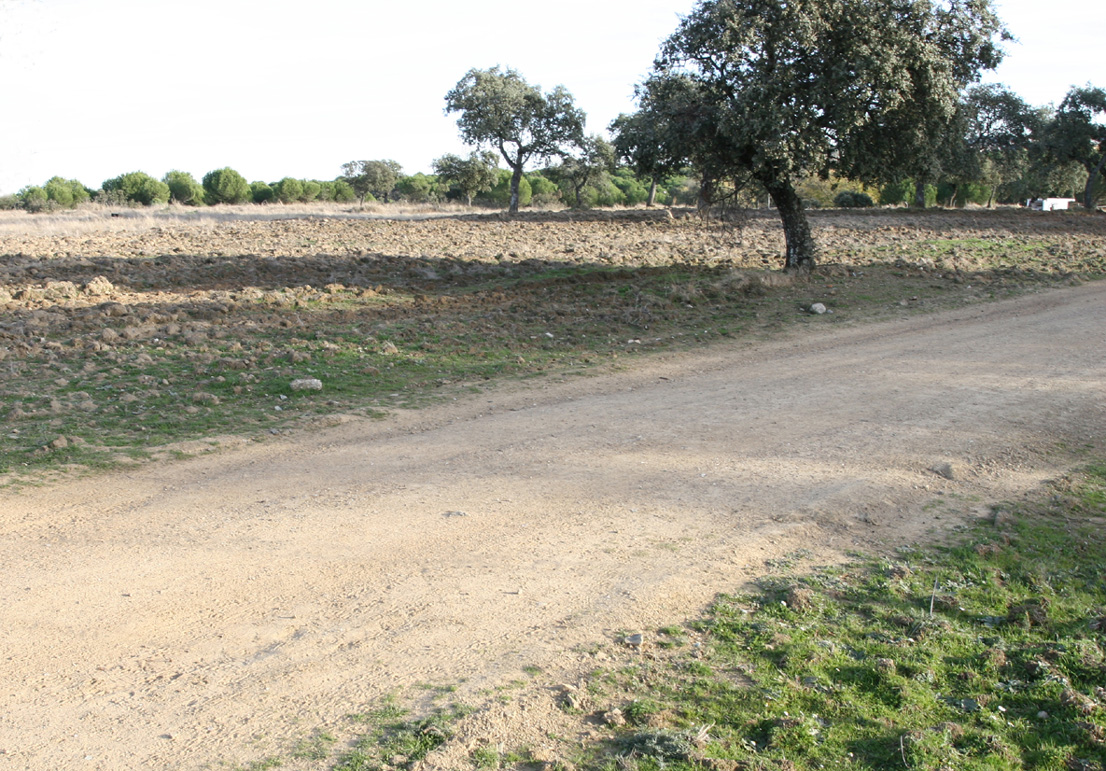
I made a picture of the narrow street of Cerro Muriano in which I think that Capa made this second photograph of refugees fleeing from the village. The people seen in the picture together with the donkey were advancing from the bottom of the street to the camera following north direction to cross the village upwards and trying to reach the railway for Obejo Train Station.

5) Picture made by Capa in Cerro Muriano area on September 5th 1936 and unknown till now. It appears in one of the pages of the aforementioned illustrated book La Lucha del Pueblo Español por su Libertad, published in 1937.

In this photograph we can see a young woman mounted on a mule and taking her baby between her arms, while she is grabbing a big umbrella to protect herself and specially the baby from the sun beams.-

Discovery of the location of this picture and that it was made by Capa: José Manuel Serrano Esparza.

On the lower area of the image we can also see a dog. Bearing in mind the shadows, this picture was made by Capa approximately between 15:20 and 15:45 h in the afternoon of September 5th 1936 around 600 hundred meters from the north entrance to Cerro Muriano village. This woman is advancing northwards towards Obejo Train Station.

              Photo: Robert Capa. © Cornell Capa / Magnum Photos

6) Picture made by Robert Capa of refugees fleeing from Cerro Muriano to save their lives, following north direction towards Obejo Train Station.- 

Virtually impossible to spot the exact location of this image, because of its very blurred background.

There are three women wearing black dresses and walking under a scorching sun: two young mothers (on the center and left, the one on the left is taking a very little baby in her arms and the one in the center is taking a blond more grown up child with his right arm while takes the arm of an old woman on the right of the frame helping her to walk) and an old woman on the right.

                    Photo: Robert Capa. © Cornell Capa / Magnum Photos

Photo: José Manuel Serrano Esparza

Photo: José Manuel Serrano Esparza

7) Vertical photography taken by Capa on September 5th 1936 at around 15:35 h in the afternoon of a woman taking in her left arm a very big checkered baggage with her belongings. She has got the back of her right hand almost touching her chin.-

Discovery of the location of this picture: José Manuel Serrano Esparza

A lot of fear is reflected on her face and she´s looking at Capa rather puzzled. Behind her you can see a telegraph post which is nowadays exactly as it was 71 years ago. This woman is walking hastily towards Obejo Train Station.

Photo: Robert Capa. © Cornell Capa / Magnum Photos


Photo: José Manuel Serrano Esparza

8) Vertical photograph taken by Capa on September 5th 1936 at around 15:45 h in the afternoon of an old woman taking a very little baby wrapped in a blanket in her arms. She shows a great deal of angst and fear and is walking very fast. One of the arms of the baby is hanging from the waist of the woman.-

Discovery of the location of this picture: José Manuel Serrano Esparza

This is another very dramatic image of people escaping from death. The telegraph post located on the right of the woman as we watch the picture, was broken after the Spanish Civil War, but the rest of this spot currently remains exactly the same. The body of the woman is hiding some big trees similar to the one appearing on the right of the frame.

This picture was taken by Capa on the spot shown in the colour picture, located by the Cordoba-Almorchon railway, on a spot between Cerro Muriano and Obejo Train Station.

Photo: Robert Capa. © Cornell Capa / Magnum Photos

Photo: José Manuel Serrano Esparza

Photo: José Manuel Serrano Esparza

9) Horizontal photograph taken by Capa on September 5th 1936 at around 17:30 h in the afternoon in a stretch of the Córdoba-Almorchón railways located in Campo Alto estate at around 8 km from Cerro Muriano and 3 km from El Vacar, with a woman on the right taking a very little child in her arms. She appears wearing a kitchen apron on her dress.-

Behind her (on the left of the frame) we can see a very young girl walking barefoot who is looking at Capa, and after her we see very probably the husband of the woman and father of both girls, clad in a black attire, cap and bearing a blanket. He´s also looking at Capa.

It is a very dramatic image. The woman isn´t looking at Robert Capa. Her sight is stray, because of the great fear and she is very anxious and worried about the security of her two daughters. It´s evident that they all have fled Cerro Muriano village full-blast to save their lives, leaving all their belongings behind.

elrectanguloenlamano.blogspot.com  was able to find, through huge sweat and above all with big luck, the exact spot of the Cordoba-Almorchon railway on which Capa made this picture: it was on a spot of the track between the stretch of Cordoba-Almorchón crossing by the landscape known as Campo Alto, near El Vacar.

Discovery of the wide area between Obejo Train Station and El Vacar called Campo Alto in which this picture was made: Patricio Hidalgo Luque. His is the main merit of this finding.

Discovery of the exact location where the picture was taken, with photographic evidence: José Manuel Serrano Esparza

THE HANS NAMUTH/GEORG REISNER PICTURES OF THE REFUGEES OF CERRO MURIANO
There are also two important pictures made in the afternoon of September 5th 1936, that though not taken by Robert Capa, but by Georg Reisner, are important because they also show the fear and suffering of the civil population who had to flee from Cerro Muriano when the Francoist planes began to bombard the village:

Photo: Georg Reisner


Photo: Georg Reisner

a) Photograph made by George Reisner and taken in Los Llanos del Conde, 1 km in the north of Cerro Muriano village, and what can be seen in the background are the mountains of the Campo de Tiro. 

Discovery of the location of this picture in the north exit of Cerro Muriano : Patricio Hidalgo Luque in 2003.

Discovery that the picture was made in Los Llanos del Conde and that tha landscape in the background are the mountains of the Campo de Tiro : José Manuel Serrano Esparza in May 2010. 

It depicts a woman who is walking with her three children in Los Llanos del Conde area towards Obejo Train Station following the Cordoba-Almorchon railway. The stress and fear to be captured is so high that the woman turns her head backwards to verify security, while she holds his youngest child between her arms. This is a picture mostly reproduced in square format, including Vu magazine of September 23, 1936, but the original negative is rectangular, because it was shot with a 35 mm camera.

Photo: Hans Namuth / Georg Reisner.

b) Photograph made by Hans Namuth in Los Llanos del Conde, approximately at 15:30 h, near the north exit of Cerro Muriano village, and are walking across the old N-432a road. 

Elrectanguloenlamano could identify the spot on which the picture was made (the Cerro de la Coja hill on the left of the image exists still currently), while the area on the right has changed very much with the elapse of time and is nowadays full of houses which were built after the Spanish Civil War) very near the north exit of Cerro Muriano village. 

Discovery of the location of this picture : José Manuel Serrano Esparza in May 2010

All the people appearing in this horizontal image (seven women - the two most on the left are taking heavy baggages, other two are crying, one more is taking a baby between her arms, and two of them are partially seen on far right of the frame and their face is not discernible-, an old man mounted on a donkey and holding a little girl with his hands, and a young man in the background wearing a black beret and taking a baby between her arms) are hastily fleeing from the Fascist bombing of Cerro Muriano and are walking fast following north direction towards the Obejo Train Station and El Vacar.

The woman most on the left of this photograph, who is grabbing a big plaided baggage with her belongings, is the same one photographed by Robert Capa approximately 1.5 km beyond this spot, in the direction of Obejo Train Station. Id est, when either Hans Namuth or Georg Reisner (who are probably with the Austrian writer Franz Borkenau) make this picture and both German photographers advance towards Cerro Muriano (being in this photograph already very near the north entrance to the village)
, Capa and Gerda Taro have advanced in opposite direction for a lot of minutes, not towards Cerro Muriano as Namuth and Reisner, but towards Obejo Train Station and El Vacar, and are now approximately mid way between Cerro Muriano and Obejo Train Station (the latter located at a distance of 5 km), and Capa will make the picture of the woman with the big plaided baggage a lot of minutes later, more in the north, with this woman walking hastily towards Obejo Train Station and on a spot by the railway Córdoba-Almorchón located around 1, 5 km from the point in which Namuth / Reisner make this picture.

Discovery of the location of this picture: José Manuel Serrano Esparza in May 2010. 

Photo: Hans Namuth.

c) A horizontal photograph in which we can see a lot of refugees fleeing from Cerro Muriano and advancing in the north exit of Cerro Muriano across the N-432 road towards Obejo Train Station and El Vacar, while two Republican militiamen are walking towards Cerro Muriano village. 

Discovery of the location of this picture : José Manuel Serrano Esparza in May 2010

All these people are on a spot very near the north entrance to Cerro Muriano village, visible in the background, with the still existing little knoll on the left, while the one on the right doesn´t exist any more, since it was progressively occupied by a lot of houses built after the Spanish Civil War, and such area is currently full of all kinds of abodes.


The picture was made from a very short distance, practically at point blank range, and on the left of the image we can see a very frightened and anguished mother, walking quickly and holding her baby in arms, and by her is her elder son, also walking and grabbing his mother´s left arm, the fear being also reflected on the face of this boy, whose chest is cut by the lower border of the image.

Just behind this woman, there´s a man walking and taking a little girl between his arms. Bearing in mind the scarce difference in age among the three children (the eldest one is wearing dark clothes and his head, neck and upper area of his chest are on the lower area of the image, the intermediate one in age is the little girl held by the young man wearing dark trousers and short sleeved clear shirt, and the youngest one is the baby taken in arms by her mother), this man is almost with utter certainty the woman´s husband, is in his thirties and clearly shows fear and stress on his face, so perhaps some of the bombs have fallen near his house. Even, his daughter who he´s taking between his arms, is looking backwards with curiosity, over his father´s right shoulder, to watch what is happening behind them.


Just on the left of the head of the mother who is walking holding her baby between her arms, we can see another woman walking hastily with his right arm stretched and taking on one of her shoulders a big baggage with all of her belongings she has managed to save.

We can also see a mature woman behind the young husband (the one on the right of the young father hasn´t even had time to take out her apron) and a man clad with the typical Andalusian countryside garb walks behind them, followed by approximately twenty more people also escaping from Cerro Muriano at full speed.


Besides, we can glimpse the head and shoulders of a woman (out of focus and whose age is not possible to guess) between the heads of the two Republican militiamen, and finally, on the top right area of the image and likewise out of focus, we can see two men (the nearest to the militiamen is wearing a clear short sleeved shirt and a beret).

In vast majority of the reproductions of this photograph which were through decades, approximately a 50% of the left half of the original 35 mm negative and around a 30% of the sky top area were cut by the editor, creating a new rectangular image very different from the original one, changes being that the whole landscape appearing on the left of the original 24 x 36 mm was cut and also a high percentage of the sky area above the heads of the scared refugees, also cutting the whole left arm and from the lower area of the woman´s youngest son towards below, along with the striped lower area of the blanket with which the mother is wrapping up her baby.


On its turn, Le Matin newspaper of September 22, 1936, reproduced this picture in a 4:3 aspect ratio chosen by the editor, who cropped approximately the 50% of the left half of the original 35 mm negative (id est, cutting a high percentage of the landscape on the left), and around 30% of the sky top area, but preserving the whole low area of the negative, including the lower chest, complete left arm and sctomach area of the woman´s elder son together with the striped lower area of the blanket with which the mother is wrapping his baby.


At the same time, the editor of this image reproduced in Vu on September 22, 1936, has preserved approximately a 5% more of image of the original negative on far right of the frame, so we can see the complete body and legs of the man more on the right of the top area of the negative (who often appears cut on his left shoulder in many of the reproductions of this picture, also being true that in the existing reproductions approaching an aspect ratio between 1.85:1 and 2.39:1, showing a high percentage of the original 35 mm negative, only the man dressed with white shirt and beret can be glimpsed - though his left shoulder has almost been cut by the right vertical limit of the image and the man walking by him on far right of the original negative doesn´t appear on the image, because on making the cut for creating a picture featuring an image with very wide ratio (approaching to the modern anamorphic widescreen cinema showings from 1970 onwards), this man has been left out of the right boundary of the image by the editor.

When Hans Namuth (who goes with the also German photographer Georg Reisner and probably with the Austrian journalist Franz Borkenau) makes this picture on a spot very near the north entrance to Cerro Muriano village, advancing with his two companions following south direction towards that village, Capa and Gerda Taro are a lot of hundreds of meters away, more in the north of the point depicted in this picture by Namuth, after having marched in opposite direction, id est, not towards Cerro Muriano village, but towards Obejo Train Station.

Such as Hans Namuth reported to Richard Whelan in an interview held in 1982, Namuth, Reisner and Borkenau didn´t see Capa and Taro at any moment during September 5, 1936, though some weeks later, when they watched in the number of Vu magazine of September 23, 1936, the pictures of refugees made by Capa in Cerro Muriano area (above all the ones made between Cerro Muriano and Obejo Train Station) they realized that Capa and Taro had already been in the zone on September 5, 1936, because one of the women photographed by Capa (who can be seen on the lower right angle of the page 1107 of the aforementioned number 445 of Vu magazine of September 23, 1936, grabbing a big plaided baggage with her belongings with he left hand, while she is walking fast fleeing from the Francoist bombing of Cerro Muriano), also appears in one of the picture taken by Hans Namuth / Georg Reisner - made within a very short elapse of time between both of them and from almost identical spot of capture with respect to the image appearing edited just on this paragraph (the one made by Namuth on whose left side there´s a mother holding her baby in her arms) and just under it with the complete frame - very near the north entrance of Cerro Muriano village which depicts this same woman accompanied by other five (one of them takes a baby in her arms) along with an old man wearing a clear colour beret who hold a young girl between his arms while he´s mounted on a white donkey, and a further old man wearing a black beret can be glimpsed in the background holding a baby in his arms).


Photo: Hans Namuth.

Photo: José Manuel Serrano Esparza


Text and Colour Photographs inscribed in the Territorial Registry of the Intellectual Property of Madrid.

Copyright Jose Manuel Serrano Esparza. LHSA

martes, 18 de mayo de 2010

BOLEX H-16 SBM: HIGH QUALITY CINEMA IN 16 MM FORMAT

By José Manuel Serrano Esparza. LHSA

A MASTERPIECE OF CRAFTSMANSHIP

The Bolex H-16 SBM is considered the best 16 mm camera ever made by the legendary Swiss maker of movie cameras and lenses. A great professional tool able to attain excellent picture quality and versatility in virtually every motion picture application, with the added benefit of light weight and compactness, equally appropriate for handheld location filming and tripod use in the studio.

Besides, both its highly rugged camera body and precision mechanism guarantee reliable operation under all kind of climate conditions, and its special double function claw is a key element for film transport and film registration, something fairly instrumental to achieve maximum image steadiness, in such a way that 16 mm cinematographic productions shot with Bolex SBM and top-notch Kern Switar and Angenieux fixed focal lenses and zooms can be blow up to 35 mm for theatrical use with very good results and the always available choice of making the conversion to Super 16 mm format.

Needless to say that this true jewel, built in every component with quality parameters and thouroughness comparable to the best Swiss manufactures of watches of Jura Valley, is a great piece of equipment to learn all the techniques of cinematography and experimental film making, thanks to its special features and accessories making up a very comprehensive system which allows the filmmaker even to generate a wide range of special effects in real time.

A high percentage of famous cinema directors learned their trade with this superb 16 mm camera which always gave them the versatility to shoot every type of filming application and every filming context.

Amazingly, the utterly mechanical Bolex SBM 16 mm film movie camera, featuring a very sturdy bayonet mount, goes on currently being used for those enthusiast of cinematography having a penchant for this outstanding format which has recently been very enhanced by the most updated 16 mm films made not only by Kodak and Fuji, but by other firms that are little by little supporting the standard.

Therefore, the image quality rendered by Bolex cameras and lenses which was already top quality during sixties and seventies, their halcyon days, has presently turned into what can be defined simply as extraordinary, thanks to the technological breakthroughs applied by firms like Kodak, Fuji, Foma, Orwo, Wittner Cinetec, etc, to their modern 16 mm cinematographic emulsions, both in black and white and colour, because during nineties and in the elapsed years of XXI century, advances regarding the lack of grain in low, standard and high sensitivity 16 mm films have been impressive and the synergy with the aforementioned top-notch Kern Switar and Angenieux primes and zooms has proved to be more and more gorgeous.

Suffice it to say that 16 mm films feature almost 1500 pixels of horizontal resolution, even more than the HDTV 720p video resolution of 1280 pixels, so filming with a Bolex SBM 16 mm or Super 16 mm movie camera is a great alternative to shoot all kind of cinematographic productions (advertisements, commercial spots, documentary films, TV programs, special animations, scientific films, all kind of theatre movies, etc, both in short and long duration) in which professional image quality is needed, and then top-notch transfers to 2K or 4K telecine can be made), taking advantage of the synchronized variable speed ESM motorizing with crystal sync position and sound, and a highly useful C mount adaptor to Bolex bayonet mount which enables the use of a very comprehensive range of top-notch classic primes and zooms of different brands with the Bolex H-16 SBM.

Being careful with the metering, taking time to make things and choosing the most suitable film and sensitivity for each production, is not hyping at all to say that the footage shot with a state-of-the-art Bolex H-16 SBM can be something amazing, not only in terms of resolving power, contrast and lack of grain attained by modern 16 mm film, but specially because of the virtually unbeatable and unique chemical emulsion aesthetics, which in my viewpoint has no match regarding sharpness, color depth and tonal range, something very apparent when watching in a big LCD or Plasma screeen the recordable Blu-ray discs including the frame by frame HD digitized telecine 16 mm that preserve that great look.

On the other hand, if you have ever the chance of watching results with the 16 mm film reels directly projected on a big cinematographic screen with for example a Bolex 421 model 16 mm optical magnetic sound projector providing electronically stabilized projection speeds, still projection and frame by frame projection, along with great sound quality with a frequency range between 30 and 20,000 cycles thanks to its 25W power output, in my viewpoint we get into the realm of the fantastic, being able to fully realize in king size the amazing levels of optical correction, corner to corner sharpness, contrast and colour rendition that the cream of Kern Switar and Angenieux primes and zooms are able to achieve when creating cinematographic images.


Cameraman shooting with a Bolex H-16 SBM with Kern Vario-Switar 100 POE 16-100 mm f/1.9 zoom lens and 400 feet magazine. We can also watch the ESM self-regulating multi-speed and electronically stabilized auxiliary motor attached to the right side of the camera body, very useful for both silent filming and sync sound filming with sync pulse generator or crystal

Detail of right side of a Bolex H-16 SBM 16 mm camera, with lavishness of chromed components everywhere.

We can see:

- The frame counter, immediately on the right of the logo (the little knurled wheel just under it being the frame reset).


- The frame speed select dial for 12, 16, 18, 24, 32, 48 and 64 fps choice is on the lower right area of the image.

- The chromed little crank - with a screw on its lower area- located between two arrows on top left is the spring disengage lever, while the metallic smaller protuberance over it is the MOT position (engaged), while the 0 just on the right of the lower arrow indicates the disengaged position.

- The rounded hollow space on southwest of the lower arrow is the footage counter, while the big elongated chromed vertical piece reaching the lowest border of the image (and extending beyond it) is the winding crank.

- The symbol with shape of T letter just on the right of the 48 fps speed is the position for timed exposure, and the one on the 24 fps speed is the position for instantaneous exposure-

- The knurled wheel (partially concealed) on the 64 fps speed is the Backwind and the utterly visible wheel just on its right, located a bit lower, is the shaft for connecting an electric motor.

- The little horizontally chromed shaft just over the BO letters of the BOLEX logo is the lever of the douser (it is in open position), which is located on the reflex viewfinder and whose mission is to close the eyepiece to prevent light from reaching and fogging the film plane through the viewfinder.

When the doser is closed, the lever is in vertical position.

On the other hand, it is important to close the douser when one´s eye is removed from the eye piece, in order to keep film from fogging.


Almost 90 years after its introduction by Eastman Kodak in 1923, the 16 mm cinematographic film, which experienced a quantum leap regarding image quality during nineties of the XX Century, thanks to breakthrough technology in the development of black and white and colour chemical emulsions (which has continued till now) getting superb results in terms of lack of grain, resolving power, tonal range, etc, is now beginning something utterly unexpected only five years ago: a second quantum leap of quality thanks to the arrival of the formidable Blu-Ray technology allowing the state-of-the-art digitization of 16 mm reels, frame by frame, with 1560 x 1080p resolution images of High Definition video recorded on a Blu-ray Disc, more than 4.8 times bigger than the 720 x 480 standard definition video.

Therefore, 16 mm standard, which began its history in 1923 as an amateur film, has become almost 90 years after its inception into a very high quality fully professional cinematographic format able to render a top-notch image quality.

Even, in my viewpoint, regarding the current cinematographic industry, blow-ups made from 16 mm films to 35 mm would be clearly detectable, but with acceptable quality in a significant percentage of cases, since the arrival of digital intermediate workflows at the beginning of XXI Century has been decisive in optimizing a lot of important parameters, to such an extent that now it is possible to achieve a
top-notch digitization from Super 16 mm to 35 mm cinematographic film with virtually no quality loss, along with a significant improvement in the blow-ups made from 16 mm film to 35 mm (in my viewpoint the latter not being a recommendable choice in the most exacting professional domain generally speaking, but if the blow-up is made through D.I. from 50, 64 or 100 ISO 16 mm film shot with for example a Bolex or Bell & Howell camera and good primes to 35 mm , results, are currently much better than it was possible only ten years ago and could be defined at least as rather decent).

Besides, the Super 16 mm format (and the Bolex H -16 SBM can be modifed to Super 16 mm format, also existing original Bolex H-16 SBM made for Super 16 mm) has become a truly very high quality pro tool, and if you directly make the blow-ups from Super 16 mm to 35 mm through D.I., results will be good, attaining high visual standards, in such a way that sometimes even experienced professionals can´t tell 35 mm from Super 16 mm blow-ups to 35 mm ones (a concept epitomized by the even much better performance of the extraordinary Arri 416, 416 Plus and 416 Plus HS Super 16 mm cameras and Carl Zeiss Ultra 16 lenses in PL mount, which are second to none in the Super 16 mm format scope).

Even if you take advantage of the now available great further choice of making the transfer of Super 16 mm movies shot with Bolex to a High Definition video format using HD video as a D.I. to later scan to 35 mm, which is a more cost effective way than the blow up to 35 mm, results can often be fantastic using 2k and 4k scans, and very good with 6k scans.


The breathtaking technology of the last generation of 16 mm films currently made by Kodak, Fuji and other firms featuring very fine grain along with great resolving power and contrast, has significantly minimized the initial drawback of the 1.33:1 native aspect ratio of the standard 16 mm when being transferred to HD 16:9 (1.78:1) which makes necessary to crop some of the top and bottom of the frame, bringing about some resolution loss, because the remarkable enlarging and reframing capacity of the most updated 16 mm chemical emulsions enables the post production firms to crop the regular 16 mm to fit the 1920 x 1080 HD aspect ratio with very little image loss. In this regard, the improvement has been great. Making a photographic comparison, it is as if till recently the croppings or reframings were made from 35 mm Fuji NPH 400 and now they´re done from the missed 35 mm Kodak Ektar 25 Professional, which enabled the photographers to make enlargements of small areas of the negative barely without image loss.

Anyhow, of course, Super 16 is more versatile to crop to 16:9, because it has a native aspect ratio of 1.66:1 ratio which is closer to HD 1.78:1.

But probably, the most important piece of news for the 16 mm Bolex camera users has been the recent great synergy that has just been achieved at the beginning of the second decade of XXI Century between the most updated 16 mm b & w and colour films and the best digital technology available for recording high quality images, id est, the Blu-ray disc, which with its great capacity of up to 50 GB and its impressive resolution of 1560 x 1080 p allows with 16 mm film the implementation of a dream come true: the transferring of all the information contained inside the chemical emulsion to a recordable Blu-ray disc through a professional digitization frame by frame and its subsequent viewing on a large 32", 42", 46", etc, Full HD 1080 LCD or Plasma televisions featuring HDMI for optimimizing the signal, a real treat for any enthusiast of cinema and specially for lovers of the classical film aspect of movies shot with chemical emulsions. This filmic aspect of 16 mm film, both in black and white and in colour, is much more discernible on the screen of a High Definition TV when playing a Blu-ray disc recorded with the reel having been transferred to it by HD professional digitization frame by frame than with the transfers made until now on DVD.

Now, with the shot 16 mm movies professionally digitized frame by frame and recorded on a Blu-ray disc, what we watch on the screen of a Full 1080 LCD or Plasma TV is a relish for any movie fan: much more colour saturation and depth than before, far superior tonal range than before,
and images that look just like the original film, something that is highly fostered by the HDMI connector (which is a key component of this breath-taking technology called Blu-ray, and is also present in the Integrated HD Home Theatre Systems featuring Blu-ray, with which the Bolex cameras users will be able to experience great thrill watching movies shot with 16 mm film, HD digitized frame by frame and recorded on a Blu-ray disc, that preserves the filmic appearance of the scenes to a remarkable degree which must be seen to be believed), since it hasn´t any video compression and doesn´t suffer of any image degradation, with the added benefit of enabling to attain outstanding deep colours, bit depth and utter colour definition, much beyond the previous lower resolution standards of DV and HDV.


Bolex H-16 SBM with Kern Vario-Switar 100 PTL 12.5-100 mm f/2 MC with Aspheron 6.5 mm, which makes up a great combination delivering a top-notch multipurpose zoom lens.

This is one more top quality variable speed zoom lens made by the Swiss firm, featuring built-in TTL exposure meter, 19 elements and an excellent coating which allows very good shots even when filming against the light.

It has a two blade automatic diaphragm (which can also be manually set) with Cds photoelectric cell in the lens behind the zoom variator and center weighted measuring field over two thirds of the image area.

Its minimal focusing distance is 1.2 meters, and it sports a special control which makes possible to sharply focus at very short distances, above all when using the amazing Aspheron wide-angle attachment, which enables to extend the widest coverage from 41º to 72º without detectable loss of quality in large optical projections on screens. 

We can see here, just on the right of the Kern Vario-Switar 12.5 - 100 mm f/2 zoom lens, the one element Aspheron 6.5 mm attachment (which is an extraordinary 0.52 x wideangle converter specifically designed for use with the multicoated Vario-Switar 100 PTL 12.5-100 mm f/2 zoom lens, even at maximum aperture and a minimum focusing distance reduced to 1 meter)which was introduced in 1976 and was an optical milestone at its time, since however astounding it may seem, it is almost 100% distortion free and practically the whole original very high image quality is preserved after its attachment, which means adding a further lens to the zoom.

When the Aspheron 6.5 mm wideangle converter is attached, the original horizontal field angle of 42º is increased up to 72º.


Lateral view of Bolex H-16 SBM with the Kern Vario-Switar 12.5-100 mm f/2 multicoated zoom lens. We can also see the left side of the camera body including the Lid Lock (black rounded button with the horizontal slot, located on the lower area), the Optical Viewfinder Bracket (the two chromed metallic components on middle left and right), the Bolex Light Meter manufactured by Gossen (on top left of the body camera), the Exposure Meter Shoe (just under the Bolex light meter), the cavity cover for the 400 feet magazine (on top of the upper rounded area of the camera body) and the carrying handle (on the quoted cavity cover).


Kern Vario-Switar 100 POE 16-100 mm f/1.9, featuring exposure meter and power zoom, available both in Bolex bayonet mount and C mount. This top class zoom lens has built-in automatic diaphragm adjustment and light measurement through the lens, and was designed for using it with Bolex cameras sporting reflex viewfinder.

In addition to its very high optical quality, it boasts a remarkable mechanical design through which the diaphragm preselection is controlled by the cable release, which is interlocked with the zoom lever.

Its fully automatic diaphragm of the galvanometer type adjusts instantly, thereby avoiding over or underexposed frames when brightness changes take place, and CDS photoresistor can be adjusted for film sensitivities from 10 to 400 ASA and camera speeds from 12 to 64 f.p.s, while manual diaphragm setting and controlled automation by limiting diaphragm movement provide a highly versatile exposure system.

On the other hand, this truly professional zoom gives the filmmaker a choice of manual zooming at any speed or smooth power zooming, with the power for the zoom motor coming from two small batteries located in the lens housing, and at the same time, it is equipped with a full aperture control for focusing at maximum brightness with the diaphragm opening utterly by depressing slightly the release on the lens or zoom lever and automatically closing down to the correct aperture before camera starts running.

The numbered components appearing in the picture are:

1) Lens Hood. 2) Focusing ring graduated in meters (from 1,2 m to infinite, in white colour) and in feet (from 4 ft to infinity, in orange colour). 3) Focal length ring. 4) Cable release. 5) Housing for exposure meter battery. 6) Push-button with diaphragm preselection cut-out. 7) Power zoom operating key. 8) Housing for power zoom batteries. 9) Push button tube. 10) Mounting ring. 11) Automatic exposure meter with a sensitivity scale of 10 to 200 ASA for all speeds and 10 to 400 ASA from 24 f.p.s. 12) Exposure meter battery checking knob. 13) Galvanometer with indication of diaphargm aperture and insufficient light warning signal, together with a manual diaphragm setting device. 14) Removable zoom lever.


Weight: 1317 g.

Field of View: 34º x 26º - 5.2º x 4º

Minimum Focusing Distance: 122 cm

Filter Size: Series IX.


More than fifty years have elapsed between this image of the Bolex reflex cameras heyday of XX Century

and this one already in the second decade of XXI Century, Now, the blossoming Blu-ray technology is starting allowing the Bolex SBM 16 mm camera users to watch on king size Full HD LCD and Plasma televisions and home theatres their beloved movies shot in chemical 16 mm and digitized frame by frame with astounding 1560 x 1080 p HD Transfer telecine, a tremendous experience which in my viewpoint approaches very much to what is still and probably will go on being the reference in terms of image quality viewing with 16 mm film, whose foundations of modularity, reliability and maximum feasible image quality projected on a screen were laid in 1953 in Osaka (Japan) by K.Sekino, M. Matsuura, Y. Minagawa and S. Yagi: a true optical projection with top-notch 16 mm projectors like Eiki SSL series, Bolex 421 with 50 mm f/1.3 lens or 35-65 mm zoom, etc.

But it is highly apparent that the great new choice of watching in king size HD digital screens the 16 mm movies made with Bolex cameras and digitized frame by frame, subsequently being recorded on a Blu-ray disc (which preserves to very great extent the superb image quality of the modern chemical emulsions, along with their unique filmic aesthetics of image -even the optical qualities of a lot of different lenses made by different brands used with the Bolex SBM when the images were shot are discernible on the screens of HDMI Full 1080p quality HD LCD and Plasma) has got a lot of advantages, specially the significant convenience of viewing at any time, the lack of necessity of a large room specifically intended for optical projection, the absence of progressive degradation of the 16 mm film as inevitably happens during each optical projection with the original analog stuff, etc.


Cameraman using a Bolex H-16 SBM 16 mm camera with Kern Vario-Switar 86 OE 18-86 mm f/2.5 zoom lens, along with 400 ft magazine and take-up motor attached on top.

We can also see the MST Constant Speed Motor attached on the right side of the camera body.

The right hand of the cameraman is grabbing a metallic electric camera grip (specifically designed for its use with the MST motor), featuring a quick coupling device and adjustable support strap which greatly help to attain a good camera stabilization when shooting handheld.

Kern Vario-Switar 86 OE18-86 mm f/2.5 zoom lens pointing upwards. Introduced in 1968, this high quality medium range zoom features an automatic diaphragm and exposure measurements are taken through the lens, with the built-in meter being sensitive to film speeds from 10 to 200 ASA. Minimum aperture is f/16.

Diagonal back view of Kern Vario-Switar 86 OE 18-86 mm zoom lens in which we can see the sturdiness and thoroughness of building typical in the Swiss firm. This is highly important, because apart from its proved excellent optical quality, the painstaking mechanical construction allows to attain very consistent results through a lot of decades, without a drop in image quality and performance.

ANGENIEUX ZOOMS FOR BOLEX H-16 SBM 

There are available a wide range of top-notch zoom lenses built by the legendary French firm Angenieux, made in C mount and usable with the Bolex H-16 SBM :


Angenieux 12-120 mm f/2.2 RX zoom lens in C mount, calculated for Bolex reflex cameras. It sports very good optical and mechanical quality for the time it was created during late sixties, exhibiting the top-notch building standard and finish of cinematographic zoom lenses made by the French optical engineer Pierre Angenieux.

Focusing is done through the reflex viewing system of the camera, so no viewfinder is necessary to use it on a Bolex H-16 reflex camera.


Pierre Angenieux, a stubborn defender of the trigonometrical design for trajectory beam rays of light, had already designed and manufactured in 1956 the first zoom lens with mechanical compensation, a 17-68 mm f/2.2, and two years later, in 1958, this mechanical compensation system enabled precise focus while zooming his new 10-120 mm f/2.5 10x zoom lens.

Six years later, on April 13, 1964, he received the Technical Award from the Academy of Motion Pictures of Hollywood (36th Academy Awards) for the design of this very good and luminous for the time 12-120 mm f/2.2 zoom lens, an impressive optical feat in that period, when the use of computers for optical ray tracing was in its dawn (the great French optical designer was bound to make a lot of painstaking hand calculation by means of highly accurate logarithmic and trigonometric tables, thousands of sheets of paper, slow tracing of single rays through different lens surfaces, etc, and didn´t have available the necessary computers to implement the curving of the front element of his sixties zooms - that were mostly flat Gauss derivatives-, also lacking modern multicoatings or the possibility of use of fluorite elements or aspherical surfaces or the movement of focusing moving an internal group to deliver a good performance in the shortest distances) and six years before the Zeiss genius Erhardt Glatzel took advantage of his adaptive optimization method in lens design to begin his research for his project of creating a new generation of retrofocus Carl Zeiss ultraluminous cinematographic primes with widest apertures between f/1.3 and f/1.75 based on the Distagon f/2 design and intended for use with Arriflex 35 mm cameras, always understanding that within the highly difficult realm in both cases, luminous zooms for 16 mm format are easier to design than zooms for 35 mm featuring the same maximum apertures, because the needed coverage is smaller.

In my viewpoint, with this very good for its time and historical 12-120 mm f/2.2 cinematographic zoom, Pierre Angenieux opened the way of the famous Angenieux professional high performance zoom lenses created for handheld filming, with which the French optical firm would receive a lot of further important prizes in future, like the Academy of Arts of Hollywood Technical Award in March 27, 1989 (61st Academy Awards) and a third Academy of Arts of Hollywood Technical Award bestowed on February 22, 2009 (81st Academy Awards) to Jacques Debize, Bruno Coumert, Christophe Reboulet and Dominique Chervin, four engineers of the thriving Thalès Angénieux (which inherited the optical legacy of the Maestro in 1993, when the legendary French designer was 86 years old), a Scientific and Technical Oscar recognizing the great optical, mechanical and cinematic qualities of the Optimo 15-40 mm and 28-76 mm zoom lenses.

Anyhow, it is important to bear in mind that vast majority of Kern Switar and Angenieux primes of the same period easily beat the performance of the Angenieux 12-120 mmf/2.2 zoom lens of the sixties, because in those days it was very difficult to make good wide angle zooms, since it was the final stage of lens designing by means of manual ray tracing with a very high quantity of 14 elements, and it was impossible to approach their performance to the level of the best fixed focal lengths as happened with Angenieux professional cinematographic zooms from late seventies, when Pierre Angenieux could fully develop his own computing methods reducing the time needed to design a lens by an order of magnitude.

However, the accuracy of criteria as to the performance of this Angenieux cinematographic zooms from sixties could be sometimes a bit iffy, because though evidently not reaching the level of quality of the primes equivalent to the different focal lengths covered by their range or the modern zooms in terms of resolution and contrast, results may greatly depend on the second hand optical and mechanical condition in which they are and how they have been maintained. Generally speaking, they will deliver good results with black and white films, but in order to avoid washed out colours chances are that it will be necessary its cleaning, collimation and overhaul by an expert.

And perhaps there´s the frequent bias of overestimating the concept of resolution, that´s to say, in my viewpoint, the most significant differences between cinematographic Angenieux zooms from sixties and most modern cinematographic Angenieux zooms made between eighties and currently are the highly improved contrast, much better colour saturation and far superior resistance to flare.

Obviously, it is true that the resolving power of the amazing modern Angenieux zooms is clearly better, but a superior contrast is more decisive in the sharpness of the look.

If we add to this that a high percentage of Angenieux cinematographic zooms from sixties were extensively attached to 16 mm TV cameras used to film news, so receiving a hard use, things are even more complex.

On the other hand, the Angenieux cinematographic zooms from sixties, though being very good for the time, focused through the movement of the front group, which was a very classic Gauss derived, and the multicoatings were often non existent or a not top quality two layer coating in the best of cases, without forgetting that the assortment of optical glass available was rather limited and didn´t include lanthanum.

This way, though the Angenieux 12-120 mm f/2.2 is a good zoom lens able to render a great aesthetics of image and perform very well with black and white film, in terms of resolving power and contrast, but specially with colour emulsions is better to use the Bolex H-16 SBM attached to Kern Switar or Angenieux primes of the same period, because in spite of the quantum leap in quality recently experienced by the 16 mm format in different significant aspects with the arrival of frame by frame HD telecine transfer to Blu-ray, the small size of the format needs the best primes for 16 mm format made from sixties till currently, the Kern-Vario Switar zooms made from sixties or the Angenieux zooms made from seventies to draw all of its potential, and the primes will always get the upper hand to attain the best possible resolving power and contrast, with the advantage of featuring more luminosity, smaller size and lighter weight.

The optical quality of lenses designed for 16 mm format has to be much higher than lenses created for 35 mm format. It is the only way to match the resolution of the smaller 16 mm format featuring a width of 10.26 mm, height of 7.49 mm, with a total of 76.84 square millimeters, and an aspect ratio of 1:37, while the 35 mm format featuring 24 x 36 mm and an aspect ratio of 1:37:1 is not so exacting in this regard, taking advantage of its bigger surface.

Weight with Viewfinder: 1091 g.

Weight without Viewfinder: 805 g.

Field of View: 50 x 37º - 5º x 3.5º

Minimum Focusing Distance: 152 cm

Filter Size: Series IX.


Angenieux 9.5-95 mm f/2.2 in C mount, another good professional old zoom from mid sixties, usable with the Bolex-H16 SBM by means of an adaptor and made by the French optical firm, preserving a maximum range near the hundred millimeters and taking the widest available focal length to 9.5 mm. Once more, the superb finish and appearance of a Pierre Angenieux design, can be defined as simply gorgeous.

It features a slow and smooth zooming with a built-in gear crank, using the "1" zoom lever to get fast zooming.

In any case, though it was optically corrected for Bolex H-16 reflex cameras (so it didn´t sport the viewfinder), the image quality given by this zoom is clearly under the one delivered by the Angenieux 12-120 mm f/2.2 (something inevitable then on stretching the widest focal length of the zoom range to 9.5 mm, and at the same time it is considered the softest 60s Angenieux zoom along with the 12-240 and the 10-150) and it also needs to be stopped down two or three diaphragms to get really good sharpness, so in my viewpoint, if the best possible results regarding sharpness and contrast is top priority, the recommended choice should be the many high luminosity top-notch Kern Switar, Angenieux, Taylor-Hobson, Kodak and Wollensak primes in different focal lengths, specially with colour film.

Weight with Viewfinder: 1610 g.

Weight without Viewfinder: 1265 g.

Field of View: 55 x 41º -5.5 x 4º.

Minimum Focusing Distance: 76.2 cm.

Filter Size: 103.5 mm
.

Angenieux 15-150 mm f/2.8 C, one of the most exotic professional zooms ever made by Pierre Angenieux, featuring an imposing aspect and delivering excellent optical and mechanical performance. The innovative design and accuracy of construction are very apparent in its outline.

With this professional zoom, specifically designed Bolex prism reflex viewfinder cameras, Pierre Angenieux reached a step beyond in image quality compared with the Angenieux 12-120 mm f/2.5 and the Angenieux 9.5-95 mm f/2.2, and besides, as well as covering Super 16 mm format and providing a standard 16 mm image with much less vignetting. 

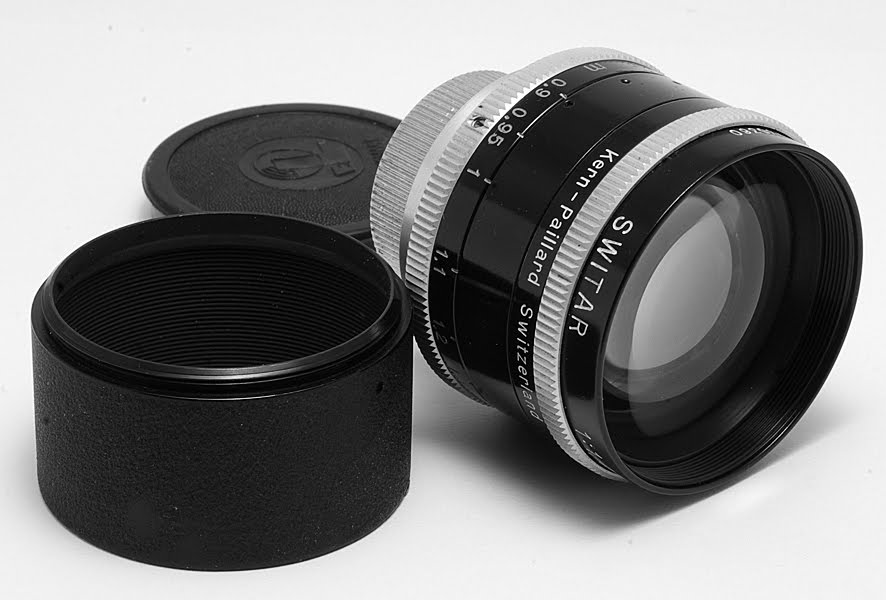
Right front diagonal view of a Bolex H-16 SBM with an ultraluminous Kern Switar 26 mm f/1.1 RX in C Mount, one of the best primes in the Kern Paillard assortment of lenses.

We can also see the large diameter and very sturdy Bolex bayonet mount, providing a professional attachment even for the big and heavy zoom lenses.

This Bolex bayonet mount is fairly instrumental in the quick changing of lenses, along with their lock-in with an easy turn of a big milled ring.


Back diagonal left view of a Bolex H-16 SBM with Kern Switar 26 mm f/1.1 RX in C Mount.

On top right of the back of the camera we can see the 14 x magnification without flicker reflex viewfinder of the Bolex H-16 SBM (one of the best ever made for any cinematographic device and whose field of view corresponds to standard 16 mm projection field) which captures the light through an exceedingly sturdy swivelling prism located in front of the shutter, with the optical system also sporting a ground glass inside the prism itself, and whose function is to avoid any misadjustment.

The viewfinder white colour attachment is the rubber eyecup, directional and that can be folded over. Just in front of it, we have got the +/- 5 diopter adjustable eyepiece, whose ring is surrounding the viewfinder.


Lateral right side view of the Bolex H-16 SBM 16 mm camera, in which we can see:

- The clutch to disengage the spring motor (just on the left of the BOLEX H16 SBM
logo, including two arrows inside a semicircle).

- The automatic
geared footage indicator (just below the clutch to disengage the spring motor, on the left), the winding handle (it is the big elongated chromed vertical bar stretching from immediately under the central area of the BOLEX H16 SBM logo, beginning with a big screw under which it features a thin rectangular empty zone, and reaching up to the lower base of the camera body).

- The frame counter (immediately on the right of the BOLEX H16 SBM logo,
the little wheel just under it being the frame reset).

- The big speed dial for 8-64 f.p.s (
located on the right of the middle area of the winding handle), the side release with lock for continuous or single frame exposures (located just on the right of the lower area of the winding handle, where it begins to become thinner).

- The i and t lever for instantaneous or time exposures in single frame mode (the little chromed knurled wheel immediately on top right of the big speed dial).

- The little wheel on top left of the i and t lever is the Backwind and the other little wheel by it, on its right, located a bit lower, is the shaft for connecting an electric motor. 

Diagonal front right view of the Bolex H-16 SBM 16 mm camera in which we can see the very sturdy bayonet mount that meant in 1970 a radical departure from the previous Bolex camera designs, since it provided a single lens reflex camera with a bayonet lens mount, whose focal flange distance is 23.22 mm, which also enables the attachment of vast majority of C Mount lenses by means of an adapter (the focal flange distance being then reduced to 17.52 mm).

We can also see the rounded chromed front release. 


Diagonal close-up of right side of the Bolex-H16 SBM 16 mm camera.

Bolex Paillard 400 feet magazine.

The middle left knurled knob is the bayonet fitting for the MM take-up motor.

Just on its right, a bit below it, is the dual scale film footage counter indicating the length of unexposed film remaining (in black for 400 feet of film on cores, and in red for 200 feet spools.

The horizontal metallic bar under the V is the light trap.

The knurled knob on middle right has the function of tensioning the feed on the feed spindle, and its arrows indicate the direction in which the knob must be turned to tension the film.

The weight of the magazine with the MM motor is 1500 g.

The 12V take-up motor model MM is for filming speeds of 10 to 32 f.p.s, including 2 guide rollers for the camera and connection cable, whereas the 12V take-up motor model WM features a 4 position switch to adjust take-up speed to filming speed, from single frame to 50 f.p.s.


Other side of Bolex Paillard 400 feet magazine.

The white horizontal rectangle on top is the jotter.

The central middle button is the magazine cover latch, while the round button with the figure 1 on its right is the magazine sequence number. Each magazine was supplied with a set of self-adhasive tabs numbered from 2 to 4.


Innards of the Bolex Paillard 400 feet magazine, made from reinforced plastic and light tight even without the cover plate. The rectangular shape baffle type light trap is visible fitted inside the film entry aperture, and its function is to prevent light entering the magazine.

This 400 feet magazine is easily mounted and removed and can take 200 feet spools or up to 400 feet of film on rolls, and is used along with the MM or the WM winding motor, which guarantees constant film tension, while a counter indicates the length of film remaining unexposed.


Bolex EM motor, designed for shooting without synchronous sound recording, being able to drive the film at speeds of 12 to 25 f.p.s.

It was created for all Bolex H-16 cameras featuring the 1:1 spindle.

It is powered by a 12 V battery and the speed is set on the camera, so to all intents and purposes it is the camera´s mechanical regulator that determines the filming speed, with an electronic current regulator preventing any overloading of the motor or camera.

It also sports a socket for connecting it to the winding mechanism of the 400 feet magazine, along with a remote control socket.

When the mechanism of the EM motor stops, the shutter is not automatically closed. 


Bolex ESM self-regulating multispeed motor, designed for shooting with synchronous sound recording and created for all H-16 cameras featuring the 1:1 spindle.

It is an electronically regulated auxiliary power supply able to drive the film at perfectly stabilizized sppeds of 10, 18, 24, 25 and 50 f.p.s, using the same crystal/sync pulse accessory as the H16 EBM electric and EL cameras.

It is powered by a 12 V battery, and also sports a built-in release, an external power socket, a remote control socket, a socket for the quoted crystal/sync pulse and an automatic clapper which fogs a few frames at the beginning of each frame.

In the same way as happened with the EM motor, the shutter is not automatically closed when the mechanism stops.


Almost sixty years have elapsed between this image of students of cinematography editing 16 mm film in 1952.

and this one of a currently in production state-of-the-art Quick Silver 16 HD Professional Telecine equipment, an example of the formidable quantum leap experienced by the 16 mm format regarding its quality of image, resolving power, attained tonal range, very nice filmic aspect, stability, adaptability for digital editing, etc, thanks to mainly two key elements: the great improvement of 16 mm emulsions accomplished by Kodak, Fuji, Foma and other brands during nineties of the XX Century (and which goes on till now) and the breathtaking new technology of Blu-ray which enables the 16 mm film enthusiasts to record their chemical productions on a recordable BD Blu-ray, attaining the utter preservation of their beloved 16 mm movies made with Bolex in High Definition 1560 x 1080p resolution images, which greatly capture and emulate on Full HD LCD or Plasma screen all the traits of the chemical film, including its unique filmic aspect, something only available till now with a good optical projection by means of an analog 16 mm projector and a cinematographic screen, always understanding that the tandem Full HD LCD or Plasma king size TV is not able to deliver 100% the unbeatable image quality of a true optical projection with a Bolex or Eiki projection on a theatre screen, but in my viewpoint differences have hugely reduced with the 16 mm reels digitized frame by frame at an HD resolution of 1560 x 1080 recorded on a Blu-ray disc (far superior to a DVD disc both in image quality, capacity and resistance to scratches, dust, humidity and heat) and subsequently played on a Blu-ray player connected through HDMI to a large Full HD LCD or Plasma tv. 

The professional High Definition scanning of 16 mm films, frame by frame, in a 1560 x 1080 resolution has meant a second quantum leap in the history of this cinematographic format, enabling to reach astounding levels of image quality, lack of grain, depth and saturation of colours, tonal range, etc, with the added benefit of also capturing the whole specific aesthetic aspect of each type of 16 mm film, both b & w and colour, a true relish for admirers of the legendary crispness and filmic aspect of chemical emulsions, now possible thanks to the recordable Blu-ray technology.

On the other hand, a skilled professional specialist making the HD frame by frame scannings directly from the emulsion side of 16 mm film stock with this High Definition telecine, has now many more possibilities than before when tackling the correction of underexposed film and the improvement of colours in faded old films - not being Kodachrome- because of the elapse of time throughout a period of many decades in which the colour pigments of 16 mm film degrade slowly and become transparent, a degradation that happens at different rates, with the reds being the longest lasting, which brings about old colour films appearing reddish, with few other colours.

The new state-of-the-art HD digitization frame by frame of 16 mm chemical film recorded on a Blu-ray disc greatly fosters the restoration of old faded film to full colour by means of the use of digital color enhancement methods that amplify the faded pigment colours but don´t amplify the red pigments.

On the other hand, it is possible now to print still images from the 16 mm movies boasting much more quality than was possible only two years ago. 


KERN SWITAR PRIMES IN C MOUNT USABLE WITH BOLEX H-16 SBM


Kern Switar 10 mm f/1.6 RX with pre-set diaphragm, one of the best moderate wideangle lenses ever made for 16 mm cameras. Here, we can see it by its original leather case.

The diagonal of Standard 16 mm format is 12 mm, so this moderate wideangle lens is equivalent to a 38 mm lens in 35 mm format or a 90 mm lens in 6 x 9 cm format.

This famous fixed focal lens was introduced in 1968 for use with Bolex H-16 reflex series models and delivers a superb image quality, even to modern standards.

In the same way as the rest of Kern Switar primes, it features Visifocus depth of field, through which on turning the diaphragm ring, the marks by the focusing ring automatically show the range of sharpness in front and behind the set distance.

Its minimum focusing distance is 2´54 cm.

Weight: 141´74 g.

Angle of view: 52º x 38º.

Front outside diameter: 40 mm.

Filter size: 5.5 drop in.


Lateral view of a black Switar 10 mm f/1.6 RX with pre-set diaphragm device.

This type of fixed focal length lenses sporting great luminosity and attaining very high marks in terms of optical and mechanical quality, are an ideal choice for filming in dim light, with the added advantage that macro lenses with diaphragm pre-settings enable to utterly open the diaphragm for focusing and readjust it to the pre-set aperture, so avoiding the need of removing the eyes from the reflex finder.


Lateral view of a chromed Kern Switar 10 mm f/1.6 RX, in which we can observe the painstaking thoroughness applied to mechanical construction in the metallic areas (including a second to none milling) matching the great optical performance.

The accuracy of the numbers and letters engraved on the front area of the lens barrel must be seen to be believed. Those were the days.

This highly luminous moderate wideangle objective belongs to the comprehensive line of fixed focal length lenses featuring Macro focusing and available for the Bolex H-16 SBM and the rest of H-16 cameras with reflex viewing.

The remarkable Macro focusing device enables that simply turning the regular focusing ring you can film both at long distances and close-ups of for example 2´54 cm (with the Kern Switar 10 mm f/1.6 RX) or 5´08 cm (with the Kern Switar 26 mm f/1.1 RX), in such a way that it isn´t needed to add any close-up lenses or extension tubes, so top-notch image quality is preserved even shooting at the shortest focusing distances.

In order to indicate that the lens is in the Macro position, there´s a red marking on the lens barrel, and an engraved index shows the necessary increase of exposure in the Macro setting.

Without pre-set device Kern Switar 10 mm f/1.6 DAADI version in RX mount with its shade. It was introduced in 1956 for H-16 series models, and can be used with the Bolex H-16 SBM. The finish quality and cosmetic beauty of this lens are amazing and the shade keeps up with them. 

Another image of a without pre-set device Kern Switar 10 mm f/1.6 1956 DAADI version in RX mount, usable with the Bolex H-16 SBM and other H-16 series camera models 

Without pre-set diaphragm Kern Switar 10 mm f/1.6 1956 DAADI version in RX mount with its very nice Paillard Bolex cap.

The main differences of this lens compared to the most modern Switar 10 mm f/1.6 RX introduced in 1968 are a minimum focusing distance of 20´32 cm (2´54 cm in the 1968 lens), a 35 mm from outside diameter (40 mm in the 1968 lens), a weight of 171 g (141´74 g in the 1968 lens), an area covered at minimum focusing distance of 12´7 cm x 17´78 cm (3´81 cm x 5´08 cm in the 1968 lens), and a length at infinity of 4´76 cm ( 5´715 cm in the 1968 lens). 

Aspheron 5.5 mm super wideangle attachment for Switar 10 mm f/1.6 RX with diaphragm preset.

This top-notch multicoated optical accessory featuring two surfaces (one aspherical and one spherical) enables to turn the Switar 10 mm f/1.6 RX into a 5.5 mm superwideangle lens, so tripling the field of view, stretching it up to 95º without detracting from the very high image quality, preserving negligible levels of distortion and needing no diaphragm correction. 


Aspheron 5.5 super wideangle optical accessory attached to a "C" mount Kern Switar 26 mm f/1.1 RX with pre-set diaphragm device

Switar 16 mm f/1.8 RX (DAESE Version). It was introduced in 1956.

Angle of View: 34º x 25º.

Minimum focusing distance: 20´32 cm.

Depth of Field Scale: Visifocus.

Length at infinity: 3´175 cm.

Front outside diameter: 35 mm.

Maximum diameter: 37 mm.

Weight: 141´747 g.

Filter Size: V


Back view of the Switar 16 mm f/1.8 RX (DAESE version). Once more, top quality noble metals used in its building and the amazing accuracy of its mechanical areas (including an adjustment of screws following patterns of Swiss horology, and as happens in practically all the Switar fixed focal length lenses, the handcrafted milling both on flat and grooved surfaces of the barrel is probably hands down the best ever accomplished in 16 mm cinematographic lenses), along with a very thorough centering of the optical elements inside it, are fundamental to attain very consistent results and superb optical performance for many decades, virtues shared by a very high percentage of the wide choice of 27 Kern Paillard lenses between 10 mm and 150 mm of the two lines (Switar and Yvar), vast majority of experts coinciding that the Switars are the best, specially in terms of resolving power and contrast. 


Kern Switar 25 mm f/1.4 RX in C Mount.

Cutaway of Kern Switar 25 mm f/1.4 RX in C Mount.

Lateral view of Kern Switar 25 mm f/1.4 RX in C Mount.

Kern Macro Switar 26 mm f/1.1 RX, introduced in 1968 for its use with Bolex H-16 reflex cameras, a high end super fast and super sharp lens, delivering astounding optical and mechanical performance, even to modern standards.

It features pre-set diaphragm device, macro extension and Visofocus depth of field scale.

This is the flagship standard lens of the Kern Paillard assortment of fixed focal length lenses, in which the Swiss company put all of its expertise to crate it, attaining a tiny lens with great maximum luminosity of f/1.1, an amazing optical and mechanical feat for the time.

Kern Macro Switar 26 mm f/1.1 RX, introduced in 1968 for its use with Bolex H-16 reflex cameras, a high end super fast and super sharp lens, delivering stellar optical and mechanical performance, even to modern standards.

It features pre-set diaphragm device, macro extension and Visifocus depth of field scale.

This is the flagship standard lens of the Kern Paillard assortment of fixed focal length lenses, in which the Swiss company put all of its expertise to create it, attaining a tiny lens with great maximum luminosity of f/1.1, an outstanding optical and mechanical feat for the time.

It is very solidly built, entirely in metal, and its focusing ring is very smooth and accurate.

The image quality it renders is simply superb, both regarding sharpness and contrast (capturing amazing amount of detail, even wide open) along with a fairly spectacular highly circular bokeh (very different from much modern lenses sporting a more linear look in the out of focus areas) which attains very lively images when shooting at great apertures between f/1.1 and f/2, greatly highlighting the isolated subjects, a very valuable asset to get creative photography.

Though bokeh topic is rather complex and often within subjective criteria, there´s no doubt that the dreamy out of focus rendering of this Kern Macro Switar 26 mm f/1.1 is unique, fantastic, and sets it in a class of its own.

On the other hand, this masterpiece lens, a beauty of precision engineering boasting a lot of character, is able to deliver great colours, enhancing them to a great extent

Weight: 170.097 g.

Angle of View: 22 x 16º.

Minimum Focusing Distance: 19´05 cm.

Length at Infinity: 6´35 cm.

Front outside diameter: 40 mm.

Filter Size: 5.5 drop in.


Kern Macro Switar 26 mm f/1.6 RX with its shade on the left and its back cap on the right.

The ultrahigh luminosity of this lens makes the use of shade a must when shooting contrejour in order to avoid flare.

The DOF pre-view lever is a great help to achieve highly accurate focus at full aperture and then closing down the diaphragm to a pre selected value.


Switar 50 mm f/1.4 RX DAIFI, without pre-set diaphragm device.

It features visifocus DOF scale.

It was introduced in 1956 for the H-16 reflex series cameras.

Minimum Focusing Distance: 91´ 44 cm.

Angle of View: 11 x 8º.

Length at Infinity with Shade: 6´35 cm.

Length at Infinity without Shade: 4´127 cm

Weight: 156 g.

Front outside diameter: 3.5 mm.

Maximum diameter: 45.5 mm.

Filter Size: VI.

Diagonal back view of Switar 50 mm f/1.4 RX DAIFI, without pre-set diaphragm device by its shade and its back cap (the latter resting on the front cap).

Kern Macro-Switar 50 mm f/1.4 RX with pre-set diaphragm in C Mount.

Vintage advertisement reporting about the Visifocus automatic depth of field featured by a high percentage of the Kern-Paillard lenses for Bolex 16 mm cameras.

Another view of Kern-Macro Switar 50 mm f/1.4 RX with pre-set diaphragm in C mount. The device for pre-setting f stops is visible on middle top. 

Another showy lateral view of a Kern-Macro Switar 50 mm f/1.4 showing the customary cosmetic beauty and superb build quality famous in the lenses for 16 mm made by the Swiss firm.

Kern Switar 75 mm f/1.9 (DAORA) in C mount, along with its detachable lens shade, front Kern Paillar chromed cap and back cap.

Weight: 226´79 g.

Depth of Field Scale: Visifocus.

Angle of View: 7º x 5º

Minimum Focusing Distance: 1´52 m.

Length at Infinity: 8´89 cm.

Length at Infinity Without Shade: 6´35 cm.

Front Outside Diameter: 43´5 mm.

Maximum Diameter: 48 mm.

Filter Size: VI


Lateral view of Kern Switar 75 mm f/1.9 (DAORA). Once more, the mechanizing of the metal components of the lens barrel, the milling of the surfaces, and the finish of the knurled rings, together with the top quality of the materials used are simply superb.

Kern-Macro Switar 75 mm f/1.4 RX in C Mount with pre-set diaphragm device, one of the best cinematographic telephoto lenses ever made and the most coveted 16 mm lens together with the Kern-Macro Switar 26 mm f/1.1 RX with pre-set diaphragm in C mount. Things like these can´t be cheap.

Yvar 75 mm f/2.8 (YVORA) with its shade and its Kern Paillard chromed front cap.

Though not so luminous and so top-notch quality as the Kern Switar 75 mm f/1.9, this telephoto lens introduced in 1950 is a very good choice regarding optical and mechanical performance, low weight and interesting price.

Weight: 141´74 g

Angle of View: 7 x 5º.

Minimum Focusing Distance: 1´52 m.

Length at Infinity: 9´52 cm.

Length at Infinity Without Shade: 5´95 cm.

Front Outside Diameter: 33 mm.

Maximum Diameter: 41 mm.

Filter Size: V


Yvar 100 mm f/2.8, a high quality telephoto lens introduced in 1963.

Its minimum focusing distance is 1´22 m.

It features Visifocus Depth of Field and built in macro extension.

Filter Size: VI

Lateral view of Macro-Yvar 150 mm f/3.3 in "C" mount, a very good quality telephoto lens with interesting luminosity and great ratio price/performance.

It was introduced in 1962.

Its minimum focusing distance is 1´83 m.

It features Visifocus Depth of Field and built in macro extension.

Filter Size: VI


Front view of Macro-Yvar 150 mm f/3.3 in "C" mount.

Bolex "C" adapter, a highly useful accessory enabling the use of a myriad of top-notch classic lenses of different brands and focal lengths on Bolex H-16 reflex cameras series and of course the Bolex H -16 SBM.

ANGENIEUX PRIMES IN C MOUNT USABLE WITH BOLEX H-16 SBM


Angenieux 5.9 mm f/1.8 superwideangle lens in C Mount, another brilliant design made by the legendary French optician. It delivers a coverage of 82º in Standard 16 mm and 93º in Super 16 mm.

In spite of the very wide field it covers, this ultraluminous objective for its very short focal length lens is rectilinear and renders negligible levels of distortion.

Inevitably, it will vignette in Bolex H-16 SBM converted to Super 16 mm, but bearing it mind its very high quality of image, its good coatings, its rendering of straight lines as straight lines and the great colours it produces, it´s a treat to use and the only so wide lens choice for 16 mm format along with the excellent Kinoptik 5.7 mm f/1.8 super wideangle.

The finish of this excellent super wideangle Angenieux lens is gorgeous, and its appearance resembles the AI-s Nikkor 8 mm f/2.8 fisheye for 35 mm format.

The anodizing in both shade and front cap is also of top quality.

Just on the letters Lens Made in France we can see the only ring existing on this lens, the one for apertures, knurled and located where the focusing ring would often be on a zoom lens. 


Inverted view of the Angenieux 5.9 mm f/1.8 superwideangle rectilinear lens. The tremendous thoroughness of milling on the metallic surfaces is very apparent, together with the very long back area of the lens, which penetrates very much inside the body of the Bolex-H16 camera when attached to it, and whose back element remains very near the film.

This lens features a fixed focus and is a great tool for shooting handheld, since it keeps the focus from approximately 10 cm to infinity. 


Angenieux 10 mm f/1.8 Retrofocus R21 in C Mount, a great choice for getting top-notch image quality with a moderate wideangle lens connected to the Bolex H-16 SBM.

Diagonal right back view of Angenieux 10 mm f/1.8 retrofocus R21 in C Mount. The cosmetic appearance of this prime, as often happens with the lenses designed by the great French optician, is on a par with its optical and mechanical qualities. These lenses of yore were made with essentially handcrafted parameters regarding the centering of the elements inside the optical cell, the accuracy of milling of the metallic surfaces, the exactness in the appropriate tightening of the screws, the wise selection of noble metals for both barrel and helicoids, etc. That´s why these fixed focal length lenses have been able to achieve a remarkable unchanged optical and mechanical performance (the latter being of top paramount importance for getting consistent high quality image results) through many decades since sixties till now.

Bell & Howell Angenieux 15 mm f/1.3 in C Mount by its front cap. Though originally designed by Pierre Angenieux for the Bell & Howell Filmo DR and HR 16 mm news reel cameras during sixties and seventies, this top quality prime can be used with the Bolex H-15 SBM through the special C adapter, getting very good image quality as to resolving power and contrast (though not stellar, bearing in mind it is a fifty years old design) and above all a very nice vintage aesthetics of image, which will highlight mainly with 16 mm monochrome films.

Another lateral view of Bell & Howell Angenieux 15 mm f/1.3 in C Mount by its front cap. The very high luminosity of this lens meant an optical tour de force for the French optical firm in the time it was incepted.

Angenieux 1 inch 25 mm f/0.95, one of the most legendary lenses ever created by Pierre Angenieux.

This ultraluminous standard lens for 16 mm cinematographic format is a great objective, though it has got a reputation of soft at the widest f/0.95 and f/1.4 apertures.

Anyhow, though being true that this lens is in most samples soft at f/0.95, it is really difficult even today, fifty-seven years later, finding a f/1 or f/0.95 lens delivering good image quality at such huge maximum aperture. We are speaking about 1953, and to have available an f/0.95 luminosity was a great optical feat then. The important thing was that though being soft, it is possible to save shootings in very low light conditions where f/1.4 is not enough, getting a simply acceptable quality, and from f/1.4 on, the lens really delivers very good quality.

This is a top-notch standard prime, but its design in 1953 (the fastest lens in the world at that time) by Pierre Angenieux was an outstanding optical tour de force, because only Zeiss and Leitz had at that moment the earliest types of computers applied to the designing of lenses since the beginning of fifties (for example Leica had the very heavy IBM 650 in Midlands, the Z5 in Wetzlar and some years later, from 1958, it had the Elliot 402F which implemented the first steps in automatic optimization), so this Angenieux 1 inch f/0.95 had to be made under highly manual parameters.

Therefore, it was virtually impossible to avoid a lens to lens variation in optical and mechanical performance, and there are samples of this lens delivering acceptable quality at f/0.95 and f/1.4 and there are others whose performance at these two apertures (specially the former) is soft. We can´t wish the performance of a Zeiss Arri 16 Ultra Prime at full aperture for the cost of the Angenieux lens and the time in which it was made.

If we bear in mind that the photographic Noctilux-M 50 mm f/1.2 Asph designed by Helmut Marx and Paul Sindel in 1966, was possible thanks to the merge between the brutal knowledge of both German designers and the help of the Elliot 402 F computer, and that in spite of it, it was also impossible for them to avoid the lens-to-lens variation and a real challenge for the manufacturing engineers to put this first Noctilux into series production, so some Noctilux-M 50 mm f/1.2 Asph are better than others, we can realize the immense talent of the French designer, who had to work greatly in the development of the Angenieux 1 inch f/0.95 following Ludwig Berthele´s working parameters.

The Angenieux 1 inch 25 mm f/0.95 is a great lens, a wonderful classical masterpiece, far from being perfect, because the perfect lens doesn´t exist and even in the best ultraluminous lenses belonging to secret military domain, lenses are always a question of compromises.

And besides, in my viewpoint, to miss in this lens (made in 1953) superlative parameters of optical performance and technical perfection of other much more perfect, much more expensive, much heavier ultraluminous objectives as Optar Illumina Super Speed Lenses, Zeiss Super Speed MkIII or Zeiss Ultra 16, which evidently deliver far superior image quality at wide apertures and are far beyond in image quality, would be a big error.

However it may be, the Angenieux 1 inch 25 mm f/0.95 can render great image quality, specially with low and medium sensitivity films including obviously not stellar but at least fully operative and acceptable image quality at f/0.95, good at f/1.4 and very good from f/2 on, always understanding that not everything related to image quality is resolving power and contrast (very important indeed) but there are other factors: acutance, rendering of the out of focus areas, aesthetics of image, abrupt or progressive transition to focused to out of focused zones, easiness of use and transportability, etc.

In my viewpoint, the price/performance ratio of this classic standard French 25 mm lens is not easily beatable in the cinematographic 16 mm realm.


Another view of the Bell & Howell Angenieux 1 inch 25 mm f/0.95, a legendary ultraluminous lens for 16 mm format, an impressive optical feat for 1953, the year in which it was launched into the market.

Among many other historical milestones, this super fast Angenieux standard lens was used for the NASA between July 28 and 31 of 1964 on board of the Ranger 7 space probe to make the first high resolution pictures of the Lunar surface, of which the first photography of the Moon ever taken by a United States spaceship was on July 31, 1964, depicting Alphonsus, Ptolemaus and Arzachel craters. 


Angenieux 100 mm f/2.5 in C Mount. 

Another view of Angenieux 100 mm f/2.5 in C Mount.

COOKE TAYLOR-HOBSON PRIMES IN C MOUNT USABLE WITH BOLEX H-16 SBM

The legendary British optical firm made from 1923 a wide range of lenses for 16 mm format, which had a tremendous influence in the development of the Standard 16 mm until turning it into a professional cinematographic format during Second World War, when different types of newsreel, combat and documentary Bell & Howell Filmo series 16 mm cameras were equipped with top-notch Taylor-Hobson lenses, of which the most known was the 1 inch f/3.5 standard lens most times equipping the Bell & Howell Filmo 70-A 16 mm camera from 1923.

It was even more fostered in 1958, when Taylor-Hobson launched into market new Cooke lenses for Bell & Howell 16 mm cameras: the 0.7 inch f/2.5 wideangle, the Serital 1 inch f/1.9, the Ivotal 1 inch f/1.4, the Ivotal 2 inch f/1.4, the Telekinic 1 inch f/2, the Telekinic 1.8 inch f/2.8, the Telekinic 4 inch f/4 and the Telekinic 6 inch f/4.5.

All these lenses are usable on the Bolex H-16 SBM by means of the special C adapter.

Bearing in mind that the 16 mm format requires more optical quality in the lenses than bigger formats than 35 mm, the contribution of the Leicester based firm was very significant in the historical professional success of the format.

Taylor & Hobson cine lenses for 16 mm format are beautifully made, with a pleasantly weighty feel and a superior satin finished metal construction. 

Cooke Taylor & Hobson Ivotal Anastigmat 1 inch 25 cm f/1.4 in C mount, a standard masterpiece lens for 16 mm format, rendering excellent optical and mechanical performance.

It was during late fifties, sixties and first half of seventies the best standard lens in the world for 16 mm cameras.


Aerial back view of Cooke Taylor-Hobson Ivotal Anastigmat 1 inch 25 mm f/1.4 in C mount. 

Taylor & Hobson Bell and Howell Super Comat 1 inch 25 mm f/1.9 in C mount. 

Another view of Taylor & Hobson Bell and Howell Super Comat 1 inch 25 mm f/1.9 in C mount 

Taylor & Hobson Seritar 1 inch 25 mm f/1.9 in C Mount.

Another view of Taylor & Hobson Seritar 1 inch 25 mm f/1.9 in C Mount.

Taylor & Hobson Cooke Ivotal Anastigmat 50 mm f/1.4 in C Mount.

Taylor & Hobson Cooke Ivotal Anastigmat 50 mm f/1.4 in C Mount.

Taylor & Hobson Cooke Telekinic 75 mm f/2.8 in C Mount.

Taylor & Hobson Cooke Panchrotal 2,8 inch 71 mm f/2.3 in C Mount.

Lateral view of Taylor & Hobson Cooke Panchrotal 2,8 inch 71 mm f/2.3 in C Mount, a lens whose presence can be defined as sumptuous, following the tradition of the legendary Leicester based British optical firm, with a global finish and painstaking milling of surfaces second to none.

Diagonal left back view of Taylor & Hobson Cooke Panchrotal 2,8 inch 71 mm f/2.3 in C Mount, a top-notch telephoto lens with sublime appearance and consistently achieving very high optical and mechanical results for a lot of decades. Those were the days.

Taylor & Hobson Vidital 8 cm f/1.5, a very luminous telephoto lens delivering great image quality and optomechanical consistency in its behaviour for years, as well as being a very useful lens when tackling dim light shooting conditions.

Cooke Taylor & Hobson Telekinic Anastigmat 95 mm f/3.3 in C Mount.

Cooke Taylor-Hobson Telekinic Anastigmat 150 mm f/4.5 in C Mount.

Taylor & Hobson Cooke telephoto Anastigmat Series III 312 mm f/5.6 in C Mount, a high quality super telephoto lens for shooting nature and wildlife. 

Another view of Taylor & Hobson Cooke Telephoto Anastigmat Series VIII 312 mm f/5.6 in C Mount.

KODAK PRIMES IN C MOUNT USABLE WITH BOLEX H-16 SBM

Since the very beginning of the 16 mm cinematographic format created by Kodak in 1923, George Eastman´s photographic firm devoted itself to the designing of lenses for 16 mm cameras
(specially Bell & Howell Filmo models), and after the demise of the company´s founder in 1932, Eastman Kodak Company in Rochester went on building superb lenses for the 16 mm format, a standard which was born as an amateur choice and quickly became a professional format from late thirties and specially during the Second World War and following decades until nowadays in 2010.

The reasons for it were that it was necessary to cover different areas of the globe and shoot all kind of war and documentary movies, as fast as possible and above all with as light and transportable equipment as feasible, the capacity for handheld filming under stressful or low visibility conditions also being of top paramount importance.

It was clear that the 35 mm movie cameras were the best choice to attain maximum image quality, but their weight, volume and much higher price in all the previous stages until getting the developed reels, also including the price of the cameras and chemical emulsions, turned the 16 mm cameras highly convenient.

The problem was the size of the format, significantly smaller than the 35 mm format, so with normal or good quality lenses, image quality attained then was simply acceptable most times.

That´s why from 1937, Rudolf Kingslake, Director of Optical Design and Engineering at Eastman Kodak Company, aware about the increasingly significance of 16 mm cinematographic format in newsreels, documentary movies, etc, along with the huge boost that had meant two years before the appearance of the Kodachrome colour film in 16 mm which exceedingly beat in both resolving power and contrast all the 16 mm chemical emulsions know till then, realized that the only way to turn the 16 mm format into a really professional domain was designing very high quality lenses. There wasn´t other way, since the small size of the 16 mm format (10.26 x 7.49 mm) required that only top-notch lenses could be used to draw its potential.

Therefore, mainly from late thirties, Eastman Kodak Company and other very important firms as Wollensak, Elgeet, etc, designed a very comprehensive assortment of top quality lenses in different focal lengths for the blossoming 16 mm format.

There are few Kodak lenses in C Mount for 16 mm cameras. Most of them feature S mount, but there are different adaptors, above all an excellent Kodak C adapter for S mount to lenses enabling to attach them to Bolex cameras, which is very worth because these objectives give great image quality, were made under very stringent optomechanical parameters and are able to work flawless already in the XXI Century, many decades after they were created, currently being both a relish to use and to watch.

It is important to bear in mind that Rudolf Kingslake, the driving force behind the Eastman Kodak Optical Department designing Kodak Cine Ektar lenses for 16 mm format, had a tremendous knowledge firstly learned during twenties from Alexander Eugene Conrady at the Imperial College of Science and Technology, which had kept a huge influence in the development of world class large lenses, specially the Cooke Taylor-Hobson ones delivering high luminosity like Opic f/2, Speedic f/2.5, Pressic f/3.5, Portric f/3.5, etc, rendering amazing image quality and consistent mechanical performance for the period.

When tackling the designing of Kodak Cine Ektar lenses for 16 mm cameras with his team of collaborators, Rudolf Kingslake had as great aim the maximum possible miniaturization, but getting at the same time top-notch optical and mechanical performance. Id est, he strived after transferring British large format parameters of image quality and painstaking mechanizing -classically embodied by Cooke Taylor & Hobson- to much smaller lenses for 16 mm format cameras, perfectly knowing in advance that it was impossible to get the far superior tonal ranges, resolving power, contrast and bokehs inherent to large format (also far superior in these regards to 35 mm), but the great English optician, alma mater of Eastman Kodak Optical Department from late thirties to his death in Rochester in 2003, had a knack for designing functional yet elegant products and managed to create with his optical department at Rochester some fantastic lenses optimized for 16 mm format, boasting a wonderful appearance and mechanizing of the metallic surfaces, painstaking centering of the elements, great sturdiness, etc, and a lot of decades after their birth, they go on delivering excellent image quality to modern standards and in some cases a unique vintage aesthetics of image.

The best Kodak lenses designed for 16 mm format and usable with the Bolex H-16 SBM are the Kodak Cine Ektar 40 mm f/1.6, the Kodak Cine Ektar 50 mm f/1.6, the Kodak Cine Ektar 63 mm f/2 and the Kodak Cine Ektar 102 mm f/2.7.


Kodak Cine Ektar Anastigmat 62 mm f/2.5 in S Mount.

Kodak Cine Ektar Anastigmat 63 mm f/2.7 in S Mount.

Kodak S Mount to C Mount adapter.

Kodak Cine Ektar 63 mm f/2 in S Mount.

Another view of Kodak Cine Ektar 63 mm f/2 in S Mount. The beauty of this lens is outstanding.

OLYMPUS ZUIKO LENSES IN C MOUNT USABLE WITH BOLEX H-16 SBM 


Olympus F. Zuiko Auto-S 38 mm f/1.8 

Vertical view of Olympus F. Zuiko Auto-S 38 mm f/1.8 in C Mount.

Impressive diagonal back view of Olympus F. Zuiko Auto-S 38 mm f/1.8 in C Mount. 

Olympus F. Zuiko Auto-S 42 mm f/1.2, a legendary very high quality ultraluminous lens designed by the Japanese optical genius Yoshihisa Maitani.

CARL ZEISS JENA PRIMES IN C MOUNT USABLE WITH BOLEX H-16 SBM 


Carl Zeiss Jena 3 inch 75 mm f/1.9 in C Mount.

SCHNEIDER-KREUZNACH PRIMES IN C MOUNT USABLE WITH BOLEX H-16 SBM 


Schneider-Kreuznach Xenon 17 mm f/0.95 in C Mount, an extraordinary lens built in limited numbers by the German optical firm. This jewel is one of the best existing lenses usable with Bolex H-16 SBM, though its price is very expensive.

Diagonal back view of Schneider-Kreuznach 17 mm f/0.95 in C mount, showing the tremendous mechanical thoroughness it boasts, which has no match among the classic lenses for 16 mm cameras of its focal length.

RANK TAYLOR-HOBSON SOPELEM PROFESSIONAL ZOOMS IN C MOUNT USABLE WITH BOLEX H-16 SBM 

Between late sixties and beginning of seventies, four contracts signed between Rank Precision Industries Ltd London and Sopelem Societe d´Optique, Precision, Electronique et Mechanique de Paris generated among other things the design of some professional cinematographic zooms in C Mount for 16 mm cameras, still delivering very good image quality to current standards and an interesting price/performance ratio, always understanding that in the same way as happens with vast majority of other highly luminous zooms for 16 mm cameras ( which were made by Kern Switar, Angenieux, Som Berthiot, etc), because of their usual size and weight, the use of a monopod or tripod is highly recommended to get the best results.

Among these Rank Taylor & Hobson Sopelem zooms, usable with the Bolex H-16 SBM, we can highlight:


Rank Taylor & Hobson Sopelem 8-26 mm f/ zoom lens in C Mount.

Another view of Rank Taylor & Hobson Sopelem 8-26 mm zoom lens in C Mount.

Rank Taylor & Hobson Sopelem 17-170 mm f/2.8 zoom lens in C Mount.

Standing view of Rank Taylor & Hobson Sopelem 17-170 mm f/2.8 zoom lens in C Mount.

Rank Taylor & Hobson Sopelem 17-170 mm f/2.8 zoom lens in C Mount by its metallic front cap. 

Another longitudinal view of Rank Taylor & Hobson Sopelem 24-180 mm f/3.7 zoom lens in C Mount by its metallic front cap. 

Rank Taylor & Hobson Sopelem 20-100 mm f/2.1 and 50-250 mm f/5 by its metallic front cap.

Rank Taylor & Hobson Sopelem 20-100 mm f/2.1 and 50-250 mm f/5, a highly versatile professional tool rendering a very high quality of image in the different focal lengths encompassed by its zoom range.

RODENSTOCK PRIMES IN C MOUNT USABLE WITH BOLEX H-16 SBM

Rodenstock Heligon 4 cm f/1.9 in C Mount.

Another view of Heligon 4 cm f/1.9 in C Mount.

KINOPTIK PRIMES IN C MOUNT USABLE WITH BOLEX H-16 SBM 


Kinoptik 5.7 mm f/1.8 in C Mount, one of the best classic wideangle lenses ever made for 16 m format, sporting a great luminosity for its focal length and excellent optical and mechanical qualities. Its levels of distortion are negligible to practical effects. It´s also a very sturdy lens, whose ruggedness allows hard professional use for a lot of decades.

HUGO MEYER PRIMES IN C MOUNT USABLE WITH BOLEX H-16 SBM

Meyer Görlitz Kino Plasmat 15 mm f/1.5 in C Mount.

Diagonal back view of Meyer Görlitz Kino Plasmat 15 mm f/1.5 in C Mount. 

LEICA PRIMES IN C MOUNT USABLE WITH BOLEX H -16 SBM

Leitz Hektor Rapid 2.7 cm f/1.4 in C Mount.

Leitz Hektor Rapid 2.7 cm f1.4 in C Mount. 

TELE-XENAR PRIMES IN C MOUNT USABLE WITH BOLEX H-16 SBM 


Tele-Xenar 75 mm f/2.8 in C Mount.

ZEIKA LENSES IN C MOUNT USABLE WITH BOLEX H-16 SBM 


Zeika Nominar 1 inch f/0.95 in C Mount, one of the most beautiful lenses ever made for 16 mm format.

Zeika 1 1/2 inch f/1.4, another exceedingly nice Japanese prime made during fifties by this mysterious firm from Tokyo which was strongly inspired on Leitz screw mount 35 mm lenses.

A further view of the Zeika 1 1/2 inch f/1.4 cinematographic lens. 

GOERZ PRIMES IN C MOUNT USABLE WITH BOLEX H-16 SBM

Goerz Hypar 75 mm in C Mount.

WOLLENSAK PRIMES IN C MOUNT USABLE WITH BOLEX H-16 SBM 

The Wollensak Optical Company was another of the legendary firms making some of the best lenses and shutters both for photographic and movie cameras during the halcyon days of Rochester.

Wollensak had been making top-notch lenses since 1905, when it bought the Rochester Lens Company and the Royal Anastigmat design, changing its name to Vitax and continuing manufacturing it as a portrait lens until 1935, continuing with a slew of top quality lenses under the Velostigmat, Raptar and other labels.

Though regarding lenses, Wollensak had always been essentially devoted to the large format photographic realm, in which it excelled, the company founded in 1902 by the German Weichs born brothers Andrew and John C. Wollensak made also very good lenses in C Mount for the thriving 16 mm movie cameras, specially from forties, when the standard 16 mm consolidated as a professional cinematographic format.

And in the same way as happened with Cooke Taylor-Hobson, Wollensak strived after making fairly miniaturized lenses for the small 16 mm format with similar optical and mechanical top-notch traits which had made famous their large format designs for decades.

Wollensak Raptar 1/2 inch 13 mm f/1.5 Wideangle in C Mount. 

Inverted view of a Wollensak Raptar 1/2 inch 13 mm f/1.5 Wideangle in C Mount.

Wollensak Raptar 17 mm f/2.7 in C Mount.

Wollensak Cine Velostigmat 1 inch 25 mm f/1.9 in C Mount.

Lateral view of Wollensak 1 inch 25 mm f/1.5 in C Mount.

Lateral view of Wollensak 1 inch 25 mm f/1.5 in C Mount with its front cap attached.

Wollensak Cine Tele 3 inch 78 mm f/4 in C Mount with its metal shade.

Another view of Wollensak Cine Tele 3 inch 78 mm f/4 in C Mount with its metal shade.

LONG TELEOBJECTIVES IN C MOUNT USABLE WITH BOLEX H-16 SBM

Tele Athenar 300 mm f/3.3 in C Mount, a very luminous super telephoto lens for the fifties, when the Hollywood firm Century Precision Optics launched its Tele-Athenar series of telephoto
objectives with focal lengths ranging between 150 and 1200 mm.

These lenses were basic in design and sported an external focus that made operation a bit cumbersome under difficult conditions, but the image quality they delivered -though not being excellent- was good, and because of their great ratio optical and mechanical performance / price, complemented by a relatively high luminosity and low weight enabling hand held shooting, were often chosed by National Geographic cameramen during fifties and sixties along with the far superior and much more heavier and expensive Kilfitt zooms.

Tele Athenar 385 mm f/4.5 with its anodized metal shade

Left diagonal back view of Tele Athenar 385 mm f/4.5

The Bolex Matte Box can be used with all H-16 cameras, but it excels with reflex models, since the reflex vewing allows an exact analysis of a comprehensive array of professional effects, as well as functioning as a top class lens shade and a gelatin filter holder.

It is available in two versions: one with a maximum extension of 30´48 cm from camera for use with zoom and regular lenses and another more compact one featuring a maximum extension of 20´32 cm for use with fixed focal length lenses up to 26 cm.

Bolex Paillard Matte Box, an accessory which highly simplifies the attaining production in the camera of a lot of professional effects such as make the same person appear different times on the same frame, masking scenes, titling, entering a room through a keyhole, split-screen techniques, wipes, simplified animation, silhouettes, etc.

Here we can see it on top of the complete Compendium Set box contents including various blank masks, acetate sheets, pre-cut keyhole, heart masks, glassplates for rear and front frame, etc.

In this picture of the Bolex Matte Box we can see the thorough finish and first quality materials used, including the first class two alluminum bars of its base.


Lateral aerial view of the Take-Up Motor used with the Bolex 400´ magazine. It bayonets directly on the magazine, eliminating the need for an awkward and trouble-prone drivebelt mechanism, so only one motor is necessary irrespective of the number of magazines used.

Back view of the Take-Up Motor used with the Bolex 400´ magazine. The power to drive this small motor comes from the battery pack of the electric camera drive by connecting a cable, and it comes with two rollers for camera spindles. Its weight is 227 g.

Innards of the Bolex H-16 SBM showing the areas through which the 16 mm film must go.

The camera features an automatic system by which either single or double perforated fim threads itself utterly though the film gate from a 100 feet spool. This is a highly valuable feature enabling quick changing of film and guarantees the adequate size of loop for faultless operation.

Besides, the film changing is even more eased by a built-in spool ejector which lifts both reels off the spindle, and there´s an automatic opening of the loop formers when the lid is place on camera.

On the other hand, in the same way that happens with other spring driven models, the front release of the Bolex H-16 SBM must be pushed in the direction of the optical axis for a smooth and jerk free releasing.

The release can either be locked in running position or the spring motor can be disengaged to prevent accidental running.

Bolex Anamorphic Accessory.

Bolex adapter for Exakta lenses, a very high quality accessory exuding ruggedness and allowing the attachment of Exakta mount lenses (the most comprehensive array of objectives from different brands ever made for a specific camera system) to the Bolex H-16 SBM and rest of reflex series Bolex cameras.

Another view of the Bolex adapter for Exakta lenses, showing the exceedingly thorough mechanizing and milling of the matallic surface often second nature for the Swiss firm, together with a high precision in the fluting of the top ring and an astonishing accuracy in the BOLEX logo engraved just over it.

RX-Fader, a very useful accessory for creating fade-ins, fade-outs and lap dissolves with H16 spring-drive cameras like the Bolex-H16 SBM. In a smooth and automatic way, it opens and closes the variable shutter over 40 frames.

Parallax corrector accessory for Bolex H-16 SBM.


The High Definition TV has meant a boost for the 16 mm cinematographic format, making much easier than before the high quality viewing of the shot movies on HD king size screens, thanks to the symbiosis between the revolutionary Blu-ray and the great improvements introduced in the most updated 16 mm films in the first decade of the XXI Century.

16 mm movies stored in their cans. The new superb digitizing HD techniques frame by frame are allowing now and will allow in future the preservation of these valuable productions in recordable Blu-ray HD discs.

In addition, there´s now the greatly enhanced choice of ordering a superb quality High Definition film transfer to a professional firm devoted to high quality HD frame by frame telecine, with the added benefit of the correction of over or underexposures, the enhancement of colours, the elimination of soft and smearing colour shifts, the prevention of colour bleed on deep colours, etc.

HDMI has meant a historical technical breakthrough for integrating and offering a direct HD video from Blu-ray recordable BD players to a HD LCD or Plasma, something which has brought about the beginning of a second quantum leap regarding image quality and covenience of viewing in the history of 16 mm film, something absolutely unexpected only five years ago.

Already in the second decade of the XXI Century, the Blu-ray recordable discs have brought new life to the professional 16 mm format, and now the enthusiasts of shooting with classical 16 mm movie cameras can achieve impressive levels of image quality, and can easily watch their productions in all of their splendour on a large size High Definition LCD or Plasma TV, in 1920 x 1080, a real treat for cinema lovers.

The arrival of Blu-ray technology with its ability to gorgeously capture the original 16 mm movies traits by means of the 1920 x 1080 High Definition frame by frame film scanning will also enable from now on the HD recording of true gems shot in 16 mm format during the last 87 years, a huge improvement in quality, since until very recently the best available choice was DVD recordable discs (720 x 576 in PAL and 720 x 480 in NTSC).

There is a wide range of brands offering recordable Blu-ray discs, a new digital means which has significantly enhanced the shooting of 16 mm chemical films, both in black and white and colour, among the enthusiasts of this cinematographic standard, who have now a very high quality alternative to the classic 16 mm projectors (Bolex, Eiki, Bell & Howell, etc) to watch their movies in all of their magnificance, because the partnership HD digitization frame by frame transferring everything to a Blu-ray disc + HDMI + 1920 x 1080 High Definition LCD or Plasma TV has considerably reduced differences in quality compared to a classical projection on a cinematographic screen which is still the reference.

The combination of classic 16 mm standard chemical emulsion with its great filmic aspect

and the state-of-the art Blu-ray technology have resulted in a dream come true:

the maximum feasible emulation of a professional cinematographic 16 mm projection on a theatre

now available privately at home,

which has meant a new dawn for the enthusiasts of 16 mm cinematographic format, a standard that approaches little by little to its century of existence, now with far superior levels of image quality, versatility, comfortable watching and unforgettable satisfactions.

Recommended Bolex pages.-

- www.bolex.ch

- www.bolexcollector.com

- homepage.newschool.edu/~schlemoj/film_courses/bolex.html including the great essay on Bolex in different chapters made by Joel Schlemowitz, with highly comprehensive information and guides for using Bolex cameras, along with painstaking details about its working, controls, types of lenses, loading, all kind of tips, etc.

- www.jkcamera.com/bolex_h16_rex.htm

- http://www.talentos.net/precios/filmacion_16mm.htm

Jose María Noriega Fernández is a world class authority on Standard 16 and Super 16 mm productions made with Bolex H-16 SBM. He is chairman and chief executive officer of VideoWorld Signal Media Group, a leading provider of advertising, video, DVD, Blu-ray, multimedia and film communications for companies in Mexico and Latin America. He has a great expertise as an executive producer and director of Marketing and Advertising TV programs, feature films, reality shows, infomercials, documentary films, short films, PSAs, commercial spots and industrial & music videos, and among his customers have been: TNT, MTV, The International Football Channel, KBS, The Weather Channel and multinational companies.

Through his professional career, he has made a lot of HDTV commercials and all kind of advertisements, working as a photography director and executive producer, shooting with Bolex H-16 SBM and chemical emulsions with different sensitivities and image aesthetics depending on the kind of movie, achieving great results with that unique filmic aspect that 16 mm cinematographic format is able to achieve when professionally digitized frame by frame to DVD and very specially to High Definition Blu-ray.

- www.cameraspro.com/bolexh16.html offering Bolex repair and S16 conversion service, along with cleaning and lubrication service.

- http://www.bolex.co.uk/ Another great Bolex site made by the world class English expert Andrew Alden, who has extensively used Bolex H16 movie cameras for a lot of decades. He´s a specialist seller of all kind of Bolex reflex cameras, lenses and accessories in excellent condition, personally checking every item and offering a highly trustworthy warranty. He also provides very useful information and advice on mechanical topics, best choices of lenses, etc. He has written three books who are a must for any Bolex enthusiast: Bolex Bible, A Bolex History and Time-Lapse and Stop-motion using the Bolex H-16.

Andrew Alden is likewise a pundit on all kinds of Bolex H16 camera outfits and has also available a special service making kits according to customers´specifications, including the upgrading to Super 16 mm format.

Bolex H-16 SBM in action:

- www.youtube.com/watch?v=Mvn2WZYkI20

- www.youtube.com/watch?v=Zd2AEJCywRA&feature=related

- www.youtube.com/watch?v=-AZhKv5tZdg&NR=1

- il.youtube.com/watch?v=Sxvf7LKQvmg

- il.youtube.com/watch?v=cuP7GWG1Fgc&feature=related

- www.youtube.com/watch?v=XdVxEa421QQ

- www.youtube.com/watch?v=4EroEZxAS3k&feature=related

- www.youtube.com/watch?v=d1AWR8BHjI4&NR=1

- il.youtube.com/watch?v=SqqOexHpIHI&feature=related

This is in my viewpoint a very interesting short to realize the great potential of 16 mm film in terms of image quality when the shot movies are professionally digitized through a top-notch telecine, frame by frame HD scanning and so forth. It is also important to bear in mind that vast majority of images shot in 16 mm existing in youtube, (because of technical limitations, HD videos are heavy and often slow to download which often also brings about image leaps and stops that don´t exist in the original footage) are very far to fully depict the great quality as to resolving power, contrast and vivid colours that standard 16 mm format is currently in the XXI Century able to offer when the film transfer is made frame by frame to an HD Blu-ray disc. However, from recent times, youtube has had the great idea of offering more and more HD videos, and I think that little by little, things will improve in this regard.

- www.youtube.com/watch?v=10fzi_OnWM0&feature=related

- www.youtube.com/watch?v=iSXHb3CXR_4&feature=related

A nice Japanese short made with a Bolex 16 mm camera and beginning with images of JR700 Bullet Trains.

- http://il.youtube.com/watch?v=GNBRx_6EiBM&feature=related

A wonderful video titled Power of 16 mm, depicting a comprehensive historical insight into this outstanding cinematographic format, including a lot of nice images and gorgeous 16 mm movie cameras and lenses.

Professor Hornsby Bolex Camera Test Tutorial:

- www.youtube.com/watch?v=Y_maYGV7Sdw&feature=related

- www.youtube.com/watch?v=lldUxSWUwTw&feature=related

- www.youtube.com/watch?v=jEBuebGtDQ8&feature=related

- www.youtube.com/watch?v=RET75Q-2Vh8&feature=related

- www.youtube.com/watch?v=pdk32OWOZG8&feature=related

- www.youtube.com/watch?v=1MdBeARTshU&feature=related