domingo, 17 de abril de 2022

INSIDE THE BUENOS AIRES (ARGENTINA) METROPOLITAN CATHEDRAL, 1955 : FIRST PHOTOGRAPHIC ASSIGNMENT FOR LISL STEINER

SPANISH 

By José Manuel Serrano Esparza.

                                                                                                                   © Lisl Steiner The Intuitive Lens 

December of 1955. 

Lisl Steiner in Vienna in 1938 being ten years old near the Sperlschule School, a few months before fleeing the Austrian capital with her parents bound for Buenos Aires (Argentina) as a consequence of the Nazi invasion of the country. © Lisl Steiner The Intuitive Lens. 

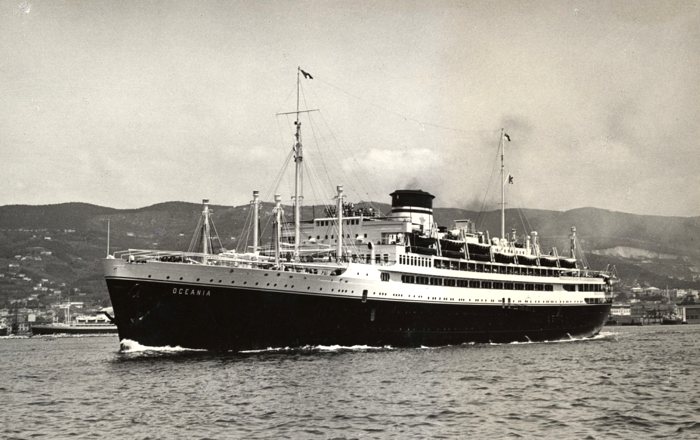
17 years have elapsed since Lisl Steiner got away with her parents Arnoldo and Katherina in 1938 from Vienna (Austria), which had been occupied by Nazi Germany, and arrived in Buenos Aires (Argentina) on September 26, 1938 

                             Original poster of the Oceania liner from Italian naval company Cosulich between Trieste (Italy) and South America. 


Lapel metallic pin used by the captain of the Oceania liner during the seven days voyage from Trieste (Italy) to Buenos Aires (Argentina) between September 19 and 26 of 1938. © jmse 


on board of the Italian Cosulich naval company Oceania liner, which had departed from Trieste (Italy) on September 19 of that year. 

From late forties and first half of fifties, Lisl Steiner had worked in Buenos Aires as a production assistant in fifty documentary films about Argentina, along with some feature films, as well as strengthening her friendship with the actress Paola Loew. 

She has decided to become a photographer a few months before, because she feels that it is her true passion.

In early December 1955 she is reported that there will be an act with presence of President Pedro Eugenio Aramburu together with military top brass and ministers within the Buenos Aires Metropolitan Cathedral.

She knows that relevant historical moments are being lived and feels the need to photograph them. 

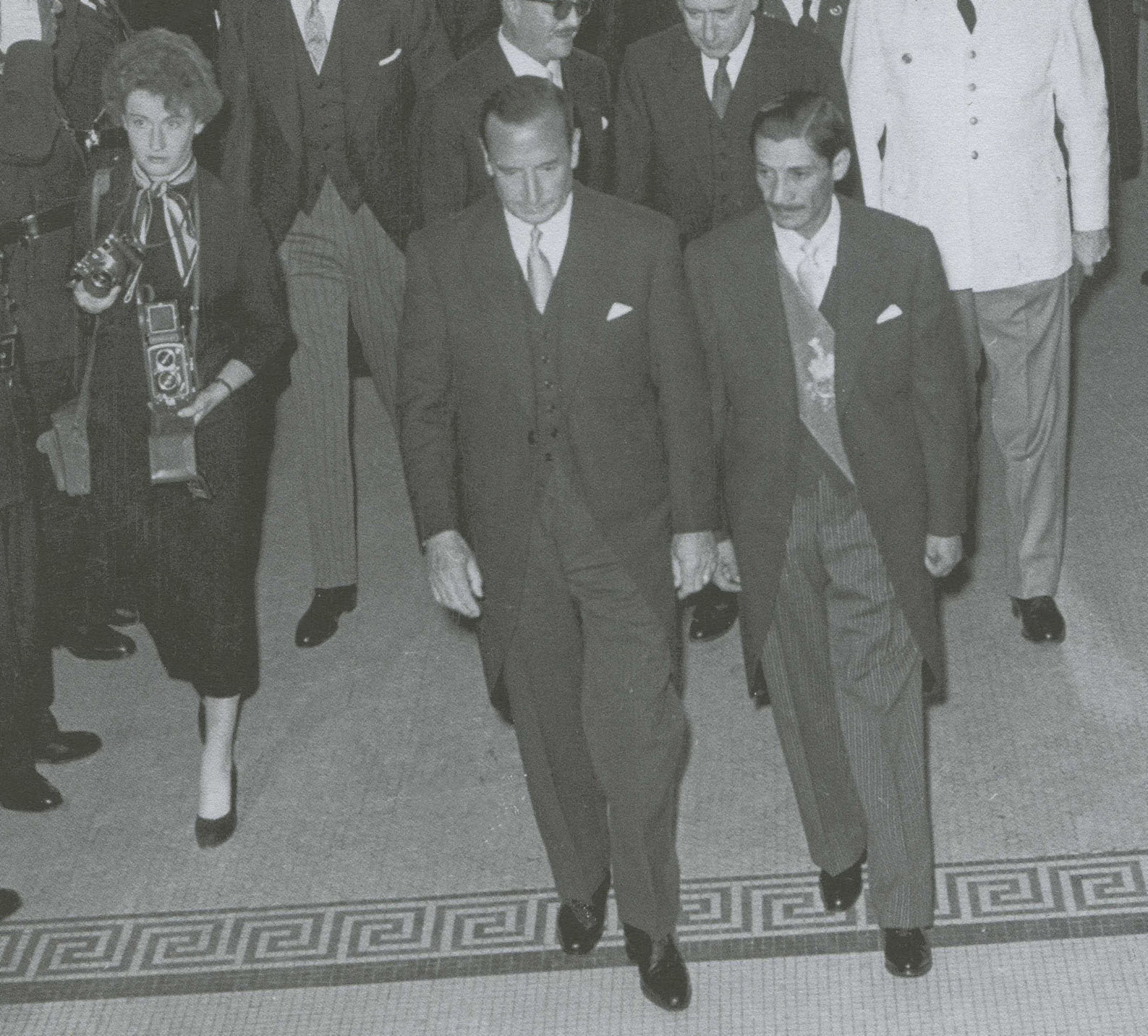
Lisl Steiner, with her customary courage and perseverence, manages to get into the act and makes her way through the high ranking military officers and ministers who advance across the inner starting area of the cathedral, until being situated behind President Aramburu, roughly 1,5 m on his right, 

                                                                                                                 © Lisl Steiner The Intuitive Lens 

instant that is captured by another photographer, who from a vantage point, gets a vertical picture including all the persons walking and the soldiers saluting them from both sides, while in the background of the image you can see a military band playing music. 

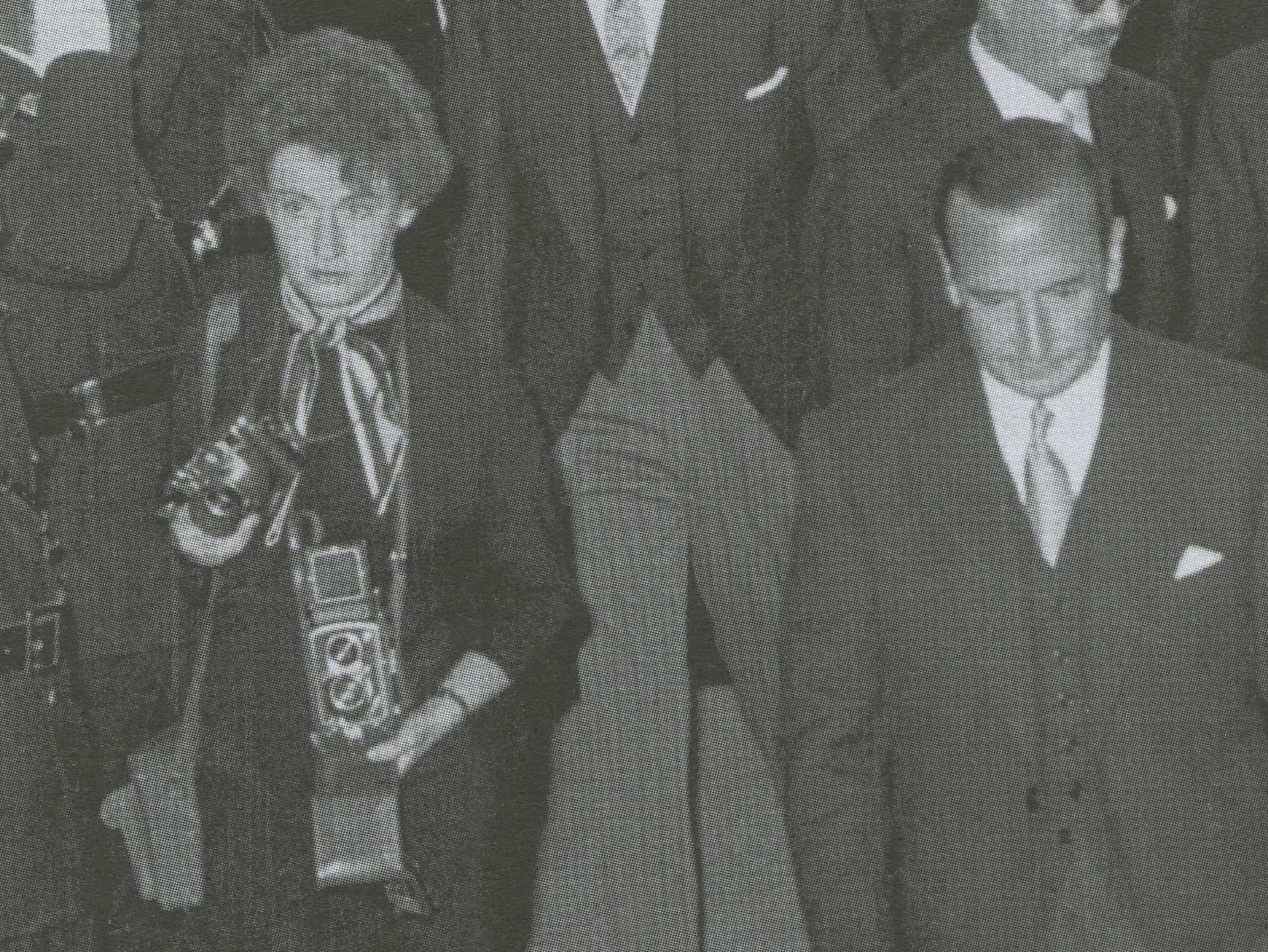
It is an exceedingly meaningful image, because Lisl Steiner´s countenance clearly shows that she is utterly concentrated, striving upon going unnoticed and doing her best to be as close as possible from general Aramburu, with the aim of making photographs of both him and his entourage from the best feasible positions when they stop their march.

Lisl Steiner features a remarkable photojournalistic flair for being at the ideal place and the most adequate instant, approaching as much as possible, with an unswerving priority : to get the picture, irrespective of any considerations regarding the technical perfection of images. 

The pictures made by Lisl Steiner during this event fifty-seven years ago haven´t been preserved, but the image made by a fellow photographer who was also inside the cathedral 

                                                                                                                  © Lisl Steiner The Intuitive Lens

distinctly unveils that she is a wholehearted instinctive and intuitive photographer, always fighting for not being detected and getting defining images from the shortest distances. 

On the other hand, the photographic gear worn by her is likewise very interesting and chosen according to the kind of work she fulfills : 

a) A 24 x 36 mm format Leica M3 rangefinder camera coupled to a collapsible Summicron-M 50 mm f/2 featuring 7 elements in 6 groups and 10 diaphragm blades and ITDOO shade.

b) A 2 1/4 x 2 1/4 medium format Rolleiflex Automat Model 3 camera (manufactured between 1937 and 1956) with Schneider-Kreuznach Xenar 75 mm f/3.5 lens. 

Both cameras and lenses are formidable photographic tools for the sort of photojournalism made by Lisl, in which agility, timing accuracy on pressing the shutter release button of the camera and speed on shooting are key factors.  

The Leica M3 features a weight of only 581 g (very small and light for the time being) and on lacking any swivelling mirror, it has a remarkable stability shooting handheld, being able to get sharp images without trepidation up to approximately 1/15 s, sometimes even less. 

And the collapsible Summicron-M 50 mm f/2 lens (1954-1968) is at the moment the best standard lens for 24 x 36 mm format on earth (after its birth in 1953, a year before the Photokina Köln 1954 in which the Leica M3 camera was introduced), occupying the throne that until then had been held for twenty-two years by the also extraordinary Carl Zeiss Jena Sonnar 5 cm f/1.5 designed by the genius Ludwig Bertele in 1932.  

Advertisement of the Leica M3 inside an American Popular Photography magazine from 1955. It had appeared a year before, during the Photokina Köln 1954 and was a great sales success internationally building up the German photographic firm even more, turning it by far into the world benchmark within 35 mm cameras, because it was and goes on being a true masterpiece of optomechanical precision and miniaturized engineering. Lisl Steiner would intensively use this camera during early sixties in the Amazon Jungle of Mato Grosso (Brazil), photographing different native tribes and capturing images which were pioneering in its scope. 

In addition, this rangefinder camera has in symbiosis with a 50 mm lens the best viewfinder (0.91x with an effective RF base of 62.33 mm) in the whole history of photography, inclusing both the analogue and digital era, from 1953 to nowadays. 

And the utterly mechanical horizontally travelling planofocal shutter sporting rubberized silk curtains (designed by Willi Stein, Dr. Ludwig Leitz and Friedrich Gath) is a real wonder of miniaturized engineering begetting a barely perceptible noise and greatly optimizing discretion during the photographic act. 

All of it with a further advantage : unlike a reflex camera, there isn´t any viewfinder blackout during the photographic act, and the shutter lag (time elapsed between the instant in which the photographer presses the shutter release button of the camera and the exposure of the film) is incredibly short, only 16 ms. 

On its turn, though it is a bigger and heavier camera (928 g) than the Leica M3, the Rolleiflex Automat Model 3 with Schneider Kreuznach Xenar 75 mm f/3.5 lens is also extraordinary and pretty useful for the photographic assignment developed by Lisl Steiner, since its 4 elements in 3 groups lens is superb and in synergy with the surface of the 2 1/4 x 2 1/4 format negative (four times larger than 35 mm one) generates an outstanding image quality, superior to the Leica M3, particularly when it comes to making selective reframings without any sharpness loss, something frequently done by picture editors of the illustrated magazines of the time. 


Advertisement of the Rolleiflex Automat Model 3 medium format camera inside one of the pages of Popular Photography magazine from October 1953, extoling both its exceptional optomechanical virtues and its stunning sturdiness and reliability. 

On the other hand, the Rolleiflex Automat Model 3 is a twin-lens reflex camera, so in addition to featuring the Schneider-Kreuznach Xenar 75 mm f/3.5 objective exposing the black and white emulsion, it has a second one, the Heidoscop Anastigmat 75 mm f/2.8 showing the image through the viewfinder.

And unlike a single-lens reflex camera, the lack of a swivelling mirror provides this medium format camera with a great shooting stability, even at slow shutter speeds, with the added advantage that in the same way as happens with the Leica M3, there isn´t any darkening of the VF during the photographic act.

Besides, the Compur-Rapid leaf shutter with 1-1/500 s + B speeds inside the lens is also very dependable and amazingly silent. 

But above all, as well as beating the Leica M3 in image quality, the Rolleiflex Automat Model 3 features a very important added perk : the possibility of shooting through the hooded waist level viewfinder, something that greatly enhances the photographer´s chances of going unnoticed on getting the pictures, because he/she hasn´t got to raise the camera at both eyes height. 

                                                                                          © Lisl Steiner The Intuitive Lens

After five years as a photojournalist in Argentina between 1955 and 1959 getting pictures for some Argentinian newspapers and the great Brazilian magazine O Cruzeiro (one of the foremost illustrated publications at international level, for which she would go on working during sixties), Lisl Steiner fixed her residence in New York (United States) in 1960 

                                                                                   Lisl Steiner in Brazil in 1960. © Lisl Steiner The Intuitive Lens 

and started a great career as a photojournalist, throughout which she would publish her images in the most prestigious illustrated magazines and newspapers in the world like Life, Time, Newsweek, The New York Times, etc, in addition to working as a photojournalist for the picture agency Keystone and appearing in reference-class photographic magazines like Leica World, 


                                                            Leica Fotografie International, Black + White Photography, 

                                             FV Foto Video Actualidad, LF Magazine Revista de Fotografía and others. 

                                                                                                                   © jmse 

Therefore, along a very extensive career of more than 65 years as a professional photojournalist, Lisl Steiner photographed a number of world-class personalities in the sphere of arts, music, politics, sport, cinema, etc, like Henri Cartier-Bresson, Oscar Niemayer, Martin Luther King, Alfred Eisenstaedt, Louis Amstrong, John Fitzgerald Kennedy, Ray Bradbury, Pelé, Robert Kennedy, Duke Ellington, Ingrid Bergman, Miles Davis, Leonard Bernstein, Cornell Capa, 

Carmen Amaya, Goddess of Flamenco Dance, photographed by Lisl Steiner during her legendary performance at the Village Night Club of New York (located on the corner of Thompson and Beeckler Street in Greenwich Village) in 1962. Twenty-one years after conquering Holywood in 1941, the skyscrapers city gave itself up to her. © Lisl Steiner The Intuitive Lens. 

Carmen Amaya, Adlai Stevenson, Richard Nixon, Franz Beckenbauer, Rod Steiger, Pau Casals, Pablo Neruda, Nat King Cole, Sir Thomas Beecham, Dwight Eisenhower, Jimmy Carter, Henry Kissinger, Andy Warhol, Erich Leinsdorf, Fidel Castro, Ronald Reagan, B.B.King, Norman Mailer, Jorge Luis Borges, Claire Yaffa, Friedrich Gulda and many more, as well as having been photographer of sessions inside the United Nations Building in New York and having worked in TV productions for companies like NBC and PBS.  

                                                                                                           © jmse 

And her pictures have been exhibited all over the world in rooms and galleries like 

the Leica Gallery of New York, Westlicht Vienna, The Room of the Austrian Cultural Forum in Bratislava, the Concrete Space Photographic Gallery of the Art Industry Movement in Miami, Faber Fotogalerie in Vienna,etc. 

                                                                                                               © Lisl Steiner The Intuitive Lens 

But this image depicting Lisl Steiner during her first photographic assignment in Buenos Aires in 1955 is highly revealing and shows a budding photojournalist oozing great passion for what she does, huge gift, intuition to spare, unutterable ability of improvisation and unflinching will to fight for being always at the adequate place, at the ideal instant and as near as possible from the people she has to photograph, always with utmost unobtrusiveness and respect, virtues that she would develop to really praiseworthy heights throughout sixties, seventies and eighties and would turn her within time into one of the most important and influential photographers of all time. 

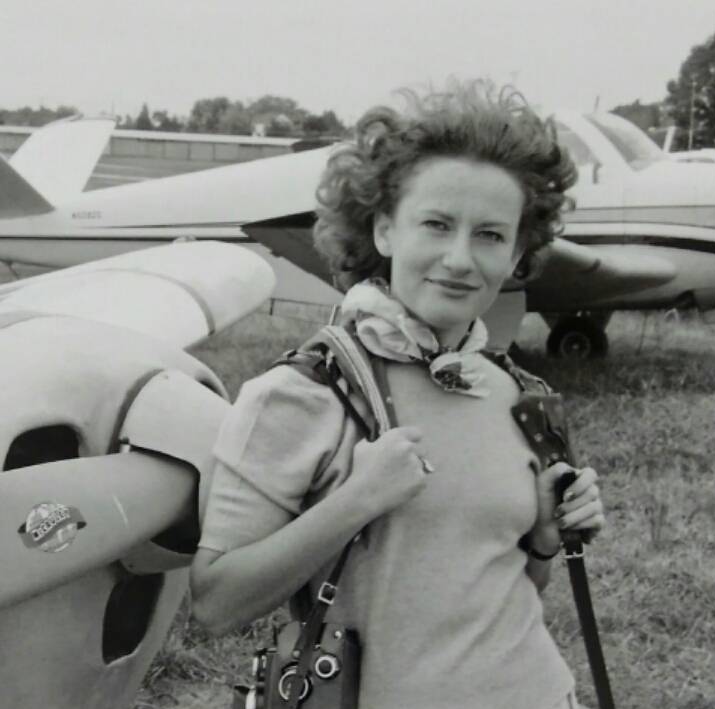
                    Lisl Steiner on August 25, 1959, a year before she decided to fix her residence in New York. © Lisl Steiner The Intuitive Lens 

                                                                                                                                             © jmse 
                                        
                                Lisl Steiner at the main balcony of the Belvedere Palace in Vienna (Austria) in 2015, 

                                                                                                                     © jmse 

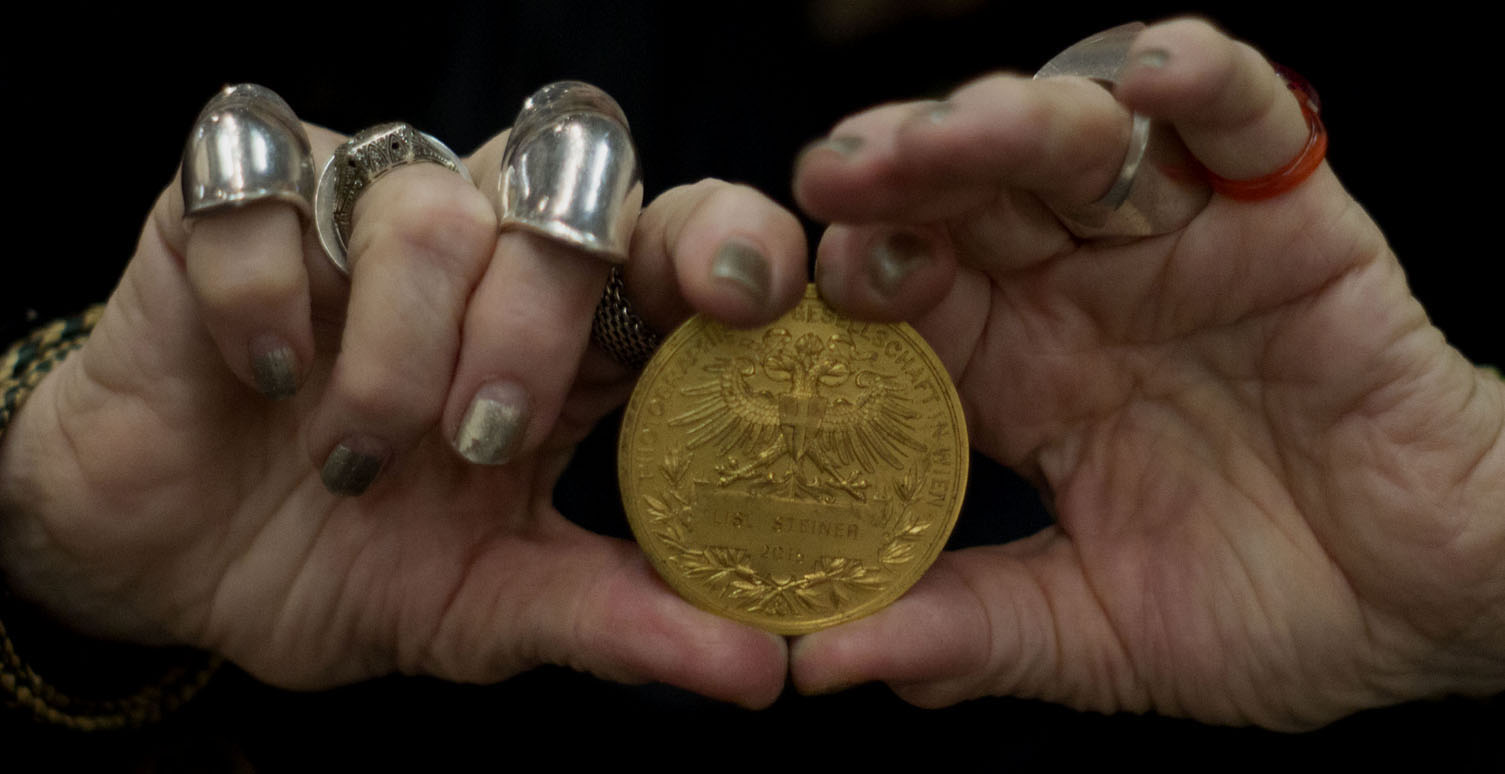
when she was bestowed the Österreich Photographische Gesellschaft (PhG) Golden Medal, highest award of the Austrian Photographic Society. 

viernes, 15 de abril de 2022

INTERIOR DE LA CATEDRAL METROPOLITANA DE BUENOS AIRES (ARGENTINA), 1955 : PRIMERA MISIÓN FOTOGRÁFICA DE LISL STEINER

ENGLISH 

Por José Manuel Serrano Esparza 

                                                                                                            © Lisl Steiner The Intuitive Lens 

Diciembre de 1955. 

Lisl Steiner en Viena en 1938 con diez años de edad cerca de la Escuela Sperlschule, pocos meses antes de huir de la capital austríaca con sus padres rumbo a Buenos Aires (Argentina) como consecuencia de la invasión nazi del país. © Lisl Steiner The Intuitive Lens 

Han transcurrido 17 años desde que Lisl Steiner huyó con sus padres Arnoldo y Katherina en 1938 de Viena (Austria), que había sido ocupada por la Alemania nazi, y  llegó a Buenos Aires el 26 de Septiembre de 1938 


                              Póster original del transatlántico Oceania de la línea naviera italiana Cosulich entre Trieste (Italia) y Sudamérica. 

Pin metálico de solapa que llevó el capitán del barco transatlántico Oceania durante el viaje de siete días desde Trieste (Italia) hasta Buenos Aires (Argentina) entre el 19 y el 26 de Septiembre de 1938. © jmse

en el transatlántico Oceania de la línea naviera italiana Cosulich, que había partido de Trieste (Italia) el 19 de Septiembre de dicho año. 

Desde finales de los años cuarenta y primera mitad de los cincuenta, Lisl Steiner ha trabajado en Buenos Aires como ayudante de producción en 50 documentales sobre Argentina, así como algunos largometrajes, además de consolidar su amistad con la actriz Paola Loew. 

Hace pocos meses que ha decidido convertirse en fotógrafa, porque siente que es su verdadera pasión.

A principios de Diciembre de 1955 recibe la información de que habrá un acto con presencia del presidente Pedro Eugenio Aramburu y más militares y ministros en el interior de la Catedral Metropolitana de Buenos Aires.

Sabe que se están viviendo momentos históricos relevantes y siente la necesidad de documentarlos. 

Lisl Steiner, con su atávico coraje y perseverancia, consigue infiltrarse dentro del acto y se abre paso entre los militares y ministros que avanzan a través de la zona de inicio del interior de la catedral, hasta situarse detrás del presidente Aramburu, aproximadamente 1,5 m a su derecha, 

                                                                                        © Lisl Steiner The Intuitive Lens

instante que es captado por otro fotógrafo, que desde una posición elevada, hace una foto vertical de todas las personas que avanzan a pie y los soldados que les saludan a ambos lados, mientras al fondo de la imagen se aprecia a una banda militar que está tocando música. 

Es una imagen muy relevante, porque se percibe claramente en la expresión facial de Lisl Steiner que está totalmente concentrada, tratando de pasar desapercibida e intentando estar lo más cerca posible del general Aramburu, para que cuando éste y su séquito detengan su marcha, pueda empezar a hacer fotos desde las mejores posiciones posibles. 

Lisl Steiner posee un gran don fotoperiodístico para estar en el lugar idóneo en el instante adecuado y aproximarse al máximo posible, con una clara prioridad : conseguir la foto, independientemente de consideraciones técnicas o de perfección de las imágenes. 

No se han conservado las fotografías hechas por Lisl Steiner durante este evento hace cincuenta y siete años, pero la imagen realizada por un compañero fotógrafo que estaba también dentro de la catedral, 

                                                                                             © Lisl Steiner The Intuitive Lens 

muestra claramente que es una fotógrafa todo instinto e intuición, siempre luchando por no ser detectada y conseguir imágenes definitorias desde las distancias más cortas. 

Por otra parte, es también muy interesante el equipo fotográfico que lleva, elegido en función del tipo de trabajo que realiza : 

a) Una cámara telemétrica Leica M3 formato 24 x 36 mm con objetivo Summicron-M 50 mm f/2 retráctil de 7 elementos en 6 grupos y 10 palas de diafragma con parasol ITDOO. 

b) Una cámara de formato medio 6 x 6 cm Rolleiflex Automat Model 3 (fabricada entre 1937 y 1956) con objetivo Schneider Kreuznach Xenar 75 mm f/3.5.

Ambas cámaras y objetivos son formidable herramientas fotográficas para el tipo de fotoperiodismo que Lisl realiza, en el que la agilidad, la discreción durante el acto fotográfico, la precisión en el timing al apretar el botón liberador del obturador de la cámara y la velocidad al disparar son también factores clave. 

La Leica M3 pesa tan sólo 581 g (muy ligera y pequeña para su época) y al carecer de espejo basculante posee una gran estabilidad de disparo a pulso, pudiendo conseguir imágenes nítidas, sin trepidación, hasta aproximadamente 1/15 s, a veces incluso menos. 

Y el objetivo Summicron-M 50 mm f/2 retráctil (1954-1968) es en esos momentos con diferencia la mejor óptica standard para formato 24 x 36 mm del mundo (tras su génesis en 1953, un año antes de la Photokina Köln 1954 en la que apareció la cámara Leica M3), ocupando el trono que hasta ese momento había ostentado durante veintidos años el también extraordinario Carl Zeiss Jena 5 cm f/1.5 diseñado por el genio Ludwig Bertele en 1932. 

Anuncio de la Leica M3 en el interior de una revista norteamericana Popular Photography de 1955. Había hecho su aparición un año antes, durante la Photokina Köln de 1954 y fue un gran éxito de ventas que consolidó internacionalmente todavía más a la empresa fotográfica alemana, convirtiéndose con diferencia en el referente mundial entre las cámaras de 35 mm, porque era y sigue siendo una auténtica obra maestra de precisión optomecánica e ingeniería miniaturizada. Lisl Steiner utilizaría intensivamente esta cámara a principios de los años sesenta en la selva amazónica del Mato Grosso (Brasil) fotografiando a diferentes tribus indígenas, captando imágenes que fueron pioneras en su género. 

Se da además la circunstancia de que esta cámara telemétrica posee en simbiosis con una óptica de 50 mm el mejor visor (0.91x y una longitud efectiva de base de telémetro de 62.33 mm) en toda la historia de la fotografía mundial, incluyendo tanto la era analógica como la digital, desde 1954 hasta hoy en día. 

Y el obturador planofocal de recorrido horizontal totalmente mecánico con cortinillas de seda engomada (diseñado por Willi Stein, Dr. Ludwig Leitz y Friedrich Gath) es una auténtica maravilla de ingeniería miniaturizada que genera un ruido apenas perceptible y optimiza en gran medida la discreción durante el acto fotográfico. 

Todo ello con la ventaja añadida de que a diferencia de una cámara réflex, no se produce oscurecimiento del visor durante el acto fotográfico y que el shutter lag (tiempo que transcurre entre el momento en que se aprieta el botón disparador y la exposición de la película) es increíblemente breve, de tan sólo 16 ms. 

Por su parte, pese a que es una cámara más grande y de mayor peso (928 g) que la Leica M3, la Rolleiflex Automat  Model 3 con objetivo Schneider Kreuznach Xenar 75 mm f/3.5 es también extraordinaria y muy adecuada para la labor fotográfica desarrollada por Lisl Steiner, porque su objetivo de 4 elementos en 3 grupos es soberbio y en sinergia con la superficie de negativo del formato medio 6 x 6 cm (cuatro veces más grande que el 35 mm) genera una gran calidad de imagen, superior a la de la Leica M3, especialmente a la hora de hacer reencuadres selectivos sin pérdida de nitidez, algo muy frecuente por parte de los editores de fotografía de las revistas ilustradas de la época. 


Anuncio de la cámara de formato medio Rolleiflex Automat Model 3 en una de las páginas de la revista Popular Photography de Octubre de 1953, ensalzando tanto sus excepcionales virtudes optomecánicas como su gran robustez y fiabilidad. 

Por otra parte, la Rolleiflex Automat Model 3 es una cámara réflex de dos objetivos, por lo que además de tener el Schneider Kreuznach Xenar 75 mm f/3.5 que es el que expone la emulsión química de blanco y negro, otro objetivo, el Heidoscop Anastigmat 75 mm f/2.8, es el que muestra la imagen a través del visor.

Y a diferencia de una cámara réflex monocular, al carecer de espejo basculante, ello confiere a esta cámara de formato medio una gran estabilidad de disparo sin vibración, incluso a velocidades de obturación bajas, con la ventaja añadida que al igual que ocurre con la Leica M3, no hay oscurecimiento del visor durante el acto fotográfico. 

Además, el obturador central Compur-Rapid con velocidades 1-1/500 s + B que incorpora el objetivo es también muy fiable y tremendamente silencioso. 

Pero sobre todo, además de aventajar a la Leica M3 en calidad de imagen, la Rolleiflex Automat Model 3 posee una muy importante ventaja añadida : la posibilidad de disparar a través del visor de capuchón a la altura de la cintura, algo que aumenta mucho las posibilidades de que el fotógrafo no sea detectado al captar las imágenes, ya que no tiene que levantar la cámara a la altura de los ojos. 

                                                                                        © Lisl Steiner The Intuitive Lens 

Tras cinco años como fotorreportera en Argentina entre 1955 y 1959 haciendo fotografías para varios medios argentinos y la gran revista brasileña O Cruzeiro (en esos momentos una de las más señeras publicaciones gráficas a nivel internacional y para la cual siguió trabajando durante los años sesenta), Lisl Steiner fijó su residencia en Nueva York (Estados Unidos) en 1960 

                                                                                       Lisl Steiner en Brasil en 1960. © Lisl Steiner The Intuitive Lens  

e inició una gran carrera como fotoperiodista, durante la cual publicaría sus imágenes en las revistas ilustradas más prestigiosas del mundo como Life, Time, Newsweek, The New York Times, etc, además de trabajar como fotógrafa para la agencia fotográfica Keystone y aparecer en revistas de fotografía de referencia a nivel internacional como Leica World

                                                           Leica Fotografie International, Black + White Photography

                                               FV Foto Video Actualidad, LF Magazine Revista de Fotografía y otras. 

                                                                                                                    © jmse 

Así pues, a lo largo de una extensísima carrera de más de 65 años como fotógrafa profesional, Lisl Steiner fotografió a personalidades de talla mundial en el ámbito de las artes, música, política, deporte, cine, etc, como Henri Cartier-Bresson, Oscar Niemayer, Martin Luther King, Alfred Eisenstaedt, Louis Armstrong, John Fitzgerald Kennedy, Ray Bradbury, Pelé, Robert Kennedy, Duke Ellington, Ingrid Bergman, Miles Davis, Leonard Bernstein, Cornell Capa, 

Carmen Amaya, Diosa de la Danza Flamenca, fotografiada por Lisl Steiner durante su legendaria actuación en el Village Night Club de Nueva York (situado en la esquina de Thompson y Beeckler Street en Greenwich Village) en 1962. 21 años después de tomar Hollywood por asalto en 1941, la ciudad de los rascacielos se rindió a sus pies. © Lisl Steiner The Intuitive Lens 

Carmen Amaya, Adlai Stevenson, Richard Nixon, Franz Beckenbauer, Rod Steiger, Pau Casals, Pablo Neruda, Nat King Cole, Sir Thomas Beecham, Dwight Eisenhower, Jimmy Carter, Henry Kissinger, Andy Warhol, Erich Leinsdorf, Fidel Castro, Ronald Reagan, B.B. King, Norman Mailer, Jorge Luis Borges, Claire Yaffa, Friedrich Gulda y muchos más, además de haber sido fotógrafa de sesiones en el interior del edificio de las Naciones Unidas en Nueva York y trabajado en producciones televisivas para cadenas como NBC y PBS. 

                                                                                             © jmse 

Y sus fotografías han sido exhibidas por todo el mundo en salas y galerías como 

la Leica Gallery de Nueva York, Westlicht Vienna, la Sala del Foro Cultural Austríaco en Bratislava, la Galería Fotográfica Concrete Space del Art Industry Movement en Miami, Faber Fotogalerie Viena, etc. 

                                                                                 © Lisl Steiner The Intuitive Lens

Pero esta imagen en la que aparece Lisl Steiner durante su primer trabajo fotográfico en Buenos Aires en 1955 es muy reveladora y muestra a una fotoperiodista en ciernes con gran pasión por lo que hace, enorme talento, intuición a raudales, inefable capacidad de improvisación e inquebrantable voluntad para intentar estar siempre en el lugar adecuado, en el momento más idóneo y lo más cerca posible de las personas a las que ha de fotografiar, siempre con la máxima discreción y respeto, cualidades todas ellas que desarrollaría hasta cotas ciertamente admirables durante los años sesenta, setenta y ochenta y que la convertirían con el paso del tiempo en una de las fotógrafas más importantes e influyentes de la historia. 

                          Lisl Steiner el 25 de agosto de 1959, un año antes de fijar su residencia en Nueva York. © Lisl Steiner The Intuitive Lens 

                                                                                                                                             © jmse 

                                   Lisl Steiner en el balcón principal del Palacio Belvedere en Viena (Austria) en 2015, 

                                                                                                                                               © jmse

cuando le fue otorgada la Medalla de Oro de la Österreich Photographische Gesellschaft (PhG), máximo galardón de la Sociedad Fotográfica Austríaca.